On this page
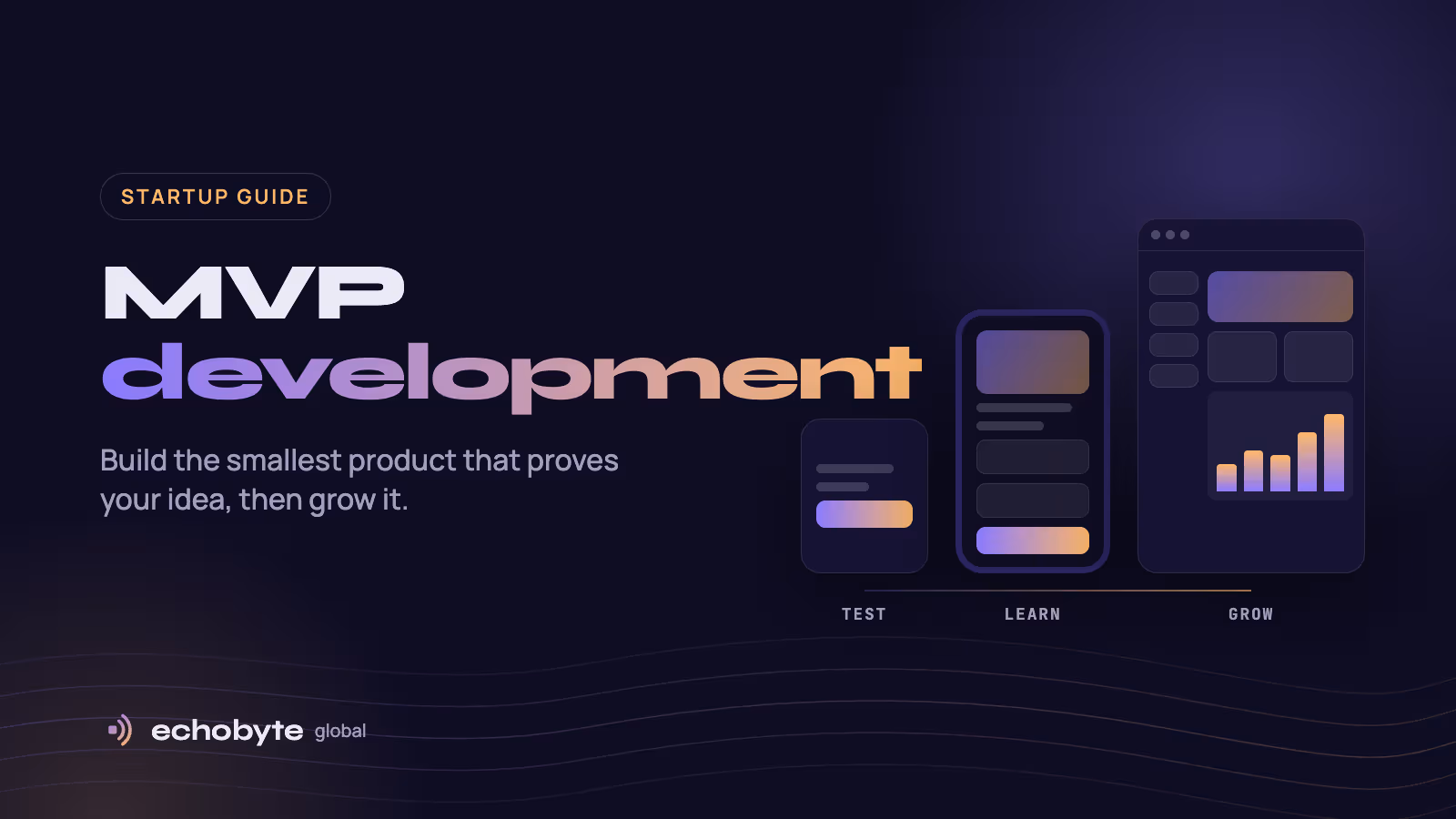
MVP development is building the smallest version of your product that real users can use, so you learn what they actually want before spending your full budget. A minimum viable product does one job well. It isn’t a demo or a half-finished app; it’s a complete answer to one problem, with everything else left out on purpose.
This guide covers what an MVP is and isn’t, the six steps we follow to build one, what it costs and how long it takes, real examples from well-known companies, and how to choose an MVP development company if you don’t build it yourself.
What is a minimum viable product?
The term was coined in 2001 by Frank Robinson and popularized by Steve Blank and Eric Ries, according to Wikipedia’s history of the concept. Ries, in The Lean Startup, defines it as the version of a product that lets a team collect “the maximum amount of validated learning about customers with the least effort.”
The important word there is learning. An MVP exists to answer a question: will people use this, and will they pay for it? Building the full product first is a bet that you already know the answer.
That bet is where most startups go wrong. In CB Insights’ analysis of 111 startup post-mortems, 35% of founders named “no market need” as a reason they failed, second only to running out of cash. An MVP tests market need early, while you still have money to change course.
MVP vs prototype vs proof of concept
These three get mixed up constantly, but each answers a different question:
| Proof of concept | Prototype | MVP | |
|---|---|---|---|
| Question it answers | Can this be built? | How will it look and work? | Will people use it and pay for it? |
| Who sees it | Your internal team | Your team, investors and a few test users | Real customers |
| Is it a working product? | No, it tests one technical idea | Usually not; clickable designs or a demo | Yes, fully working for its core job |
| Typical time | Days to a few weeks | 1 to 4 weeks | 2 to 4 months |
Most projects go from prototype to MVP. You only need a proof of concept first when there’s real technical risk, such as whether an AI model is accurate enough or whether two systems can talk to each other.
The MVP development process in six steps
This is the process we follow with founders. Steps one to three take a few weeks and cost little; they’re what make steps four to six succeed.
1. Define the problem and the user
Write one sentence: “[Type of person] struggles with [problem], and today they [current workaround].” Then talk to 10 to 15 people who fit that description. If they don’t recognize the problem, or the workaround is good enough, you’ve just saved months of building.
2. List every feature, then cut
Write down every feature you can imagine, then sort them into must-have, nice-to-have and later. Keep only the features needed for one complete journey, such as “sign up, book a session, pay”. Everything else waits until users ask for it.
3. Design and prototype
Map the screens for that one journey, then build a clickable prototype in a design tool like Figma. Put it in front of a handful of target users and watch where they get stuck. Fixing a confusing screen now costs hours; fixing it after launch costs weeks.
4. Build
Choose tools that are quick to change: one cross-platform codebase for iPhone and Android, a modern web framework, and ready-made services for sign-in, databases and payments. Work in one- or two-week cycles with a demo at the end of each, so nothing drifts from the plan.
5. Launch to a small group and measure
Decide what success looks like before you launch, for example “40% of sign-ups complete a booking in their first week”. Release to a small group of early users, add analytics, and talk to them often.
6. Learn and decide
Compare the results with your target. Ries calls this the build-measure-learn loop: you either keep going and add the next feature, change direction, or stop before spending more. All three are good outcomes compared with launching a full product nobody wants.
How much does MVP development cost?
Most app projects reviewed on Clutch cost between $10,000 and $49,999, according to its 2026 pricing guide, and a focused MVP usually sits inside that band. Here’s what different kinds of MVP typically cost and take, based on the projects we scope:
| Type of MVP | Typical cost | Typical timeline |
|---|---|---|
| Landing page or no-code test | Under $5,000 | 1 to 3 weeks |
| Web app on one platform | $10,000 to $30,000 | 6 to 10 weeks |
| Mobile app for iPhone and Android, one codebase | $20,000 to $50,000 | 10 to 16 weeks |
| MVP with complex integrations or compliance needs | $50,000 and up | 4 to 6 months |
The biggest factor is your feature list, followed by how many platforms you need and how much custom design you want. Our app development cost guide breaks down each factor, plus the ongoing costs to budget for after launch.
MVP examples from well-known companies
Some of the best-known MVPs involved very little software.
- Dropbox: a demo video. Syncing files was hard to explain and hard to build, so founder Drew Houston recorded a short video showing how the product would work. The beta waiting list grew from 5,000 to 75,000 people overnight, as Shortform’s account recounts. That proved demand before the hard engineering was finished.
- Zappos: photos of someone else’s stock. To test whether people would buy shoes online, the founder photographed shoes in local stores and posted them on a simple website. When an order came in, he bought the pair at the store and shipped it himself.
- Airbnb: a spare room. The founders rented out air mattresses in their own San Francisco apartment during a busy conference, using a basic website. Real guests paying real money showed the idea worked before they built a platform.
Each one tested the riskiest assumption, will people want this?, with the least work possible. Your MVP should do the same, even if it ends up being a real app rather than a video or a landing page.
How to choose an MVP development company
If you’re hiring a team to build your MVP, look for these five signs of a good partner:
- They ask about your users before your features. A good team wants to understand the problem before quoting a price.
- They push back on scope. If they agree to build everything on your list, they’re building a full product, not an MVP.
- They’ve launched MVPs you can try. Ask for live examples and what happened after launch.
- They work in short, fixed-price phases with a demo at the end of each, so you see progress every week or two.
- You own everything. The code, design files and app store accounts should be yours once you’ve paid.
Common MVP mistakes to avoid
- Too much “product”, not enough “minimum”. Adding “just one more feature” before launch is the most common way MVPs run over budget and miss their window.
- Too much “minimum”, not enough “viable”. An app that crashes or confuses people teaches you about your bugs, not your market.
- No success measure. Without a target set before launch, every result looks encouraging.
- Building on throwaway code. Choose tools you can grow on, so a successful MVP doesn’t need a full rebuild.
MVP development FAQ
What does MVP stand for?
MVP stands for minimum viable product: the simplest version of a product that real customers can use, built to learn whether the idea works.
How long does it take to build an MVP?
A web or mobile app MVP usually takes 6 to 16 weeks. A landing page or no-code test can be ready in 1 to 3 weeks.
How much does an MVP cost?
Most app MVPs cost between $10,000 and $50,000. Testing demand with a landing page or no-code tool can cost under $5,000.
What’s the difference between an MVP and a prototype?
A prototype shows how a product will look and work, usually as clickable designs. An MVP is a working product that real customers use, so it tells you whether they want it.
Should my MVP be a web app or a mobile app?
Start where your users are. A web app is usually faster and cheaper to change. Choose mobile if people need it on the go or it relies on phone features like the camera, location or notifications.
What happens after the MVP launches?
You measure results against the target you set, talk to users, then decide whether to keep building, change direction or stop. The features you add next should come from what users do, not from your original wish list.
Have an idea to test? We help founders scope and build MVPs, from custom web apps to iPhone and Android apps, and every project starts with a free discovery call.