On this page
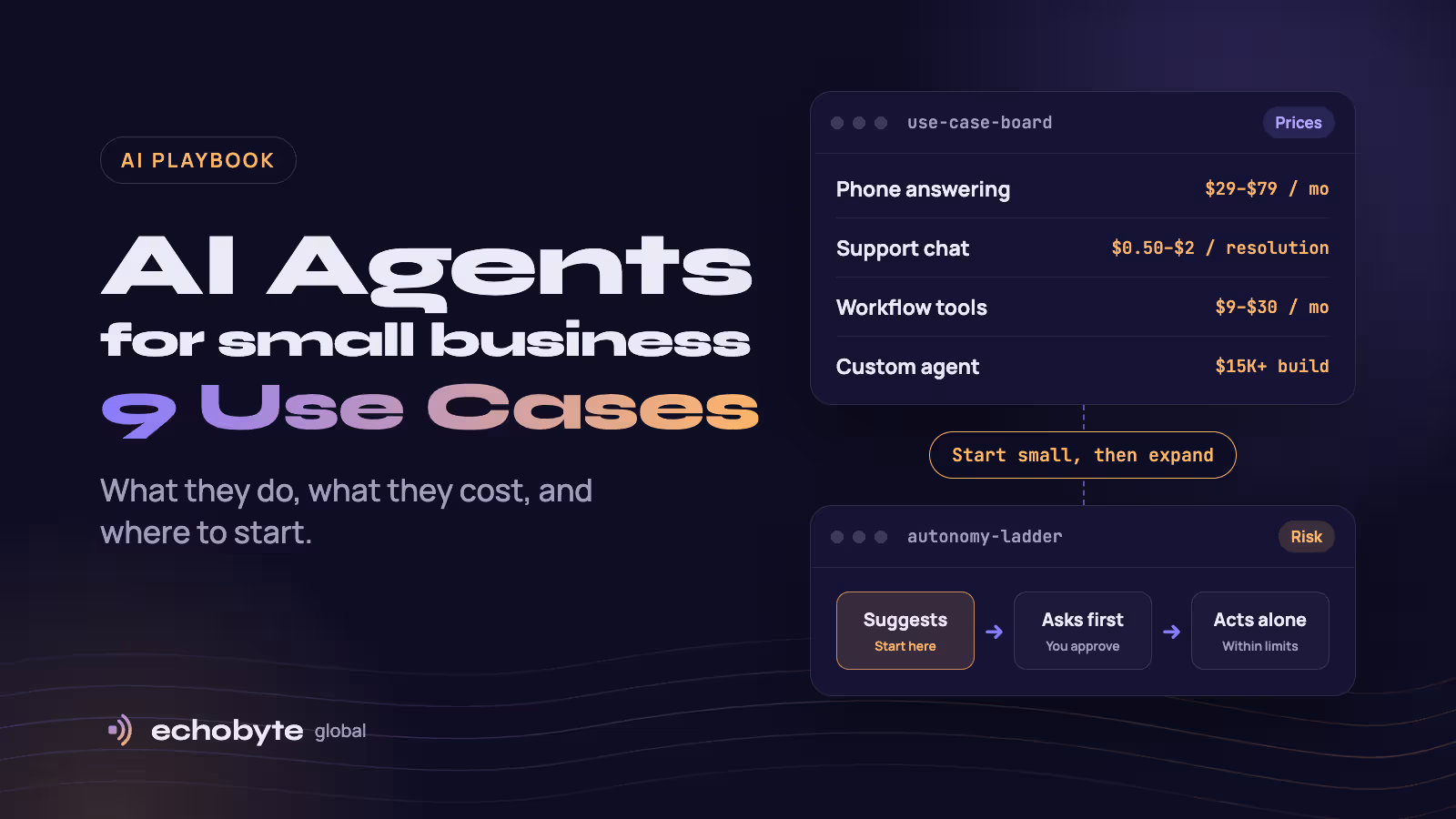
AI agents are worth it for a small business when the task is frequent, follows clear rules and costs little if it goes wrong. The best-proven uses are answering routine calls and chats, qualifying leads, sorting email, scheduling and reading invoices. Ready-made tools cost roughly $30 to $300 a month, and a custom agent costs $15,000 or more to build. Many tasks do not need an agent at all, and a simple automation or chatbot does the job for less.
This guide explains what an AI agent is, how many small businesses really use AI, nine use cases with typical costs, how to choose between buying, no-code tools and a custom build, and how to start in a week. We build AI agents and automation as part of our custom software work, so we also say when we would not build one. Prices were checked in October 2026.
Key takeaways
- Use the simplest tool that works. Fixed rules need an automation, repeated questions need a chatbot, and an agent earns its cost where inputs vary and decisions need judgment.
- Start with a task that repeats often, has clear rules and is cheap to get wrong, and keep a person in the loop at first.
- Ready-made options include AI receptionists from about $29 to $99 a month and support agents at about $0.50 to $2.00 per resolved conversation.
- No-code tools such as Zapier, Make and n8n cost roughly $9 to $30 a month to start, and they bill in different units.
- Build custom only when the work spans several systems, needs compliance controls or is unique to your business.
What is an AI agent, and how is it different from a chatbot?
An AI agent is software that uses a language model to pursue a goal. It decides the next step, uses tools such as your calendar, CRM or email, and escalates to a person when it is unsure. A chatbot answers questions. A rule-based automation follows steps you define in advance.
| Tool | What it does | Example | Typical cost | Best when |
|---|---|---|---|---|
| Rule-based automation | Follows fixed steps you define | Send each form submission to your CRM and email a confirmation | About $9 to $30 a month on a no-code platform | The rules never change |
| Chatbot | Answers questions from your own content | A website assistant that answers FAQs | Free to a few hundred dollars a month | Questions repeat and the answers are in writing |
| AI agent | Pursues a goal, picks its own steps, uses tools and escalates | Qualifies a lead, books a call and updates your CRM | About $30 to $300 a month ready-made, $15,000+ custom | Inputs vary and decisions need judgment |
Leanware notes that when a deterministic workflow can do a job reliably, it is cheaper and more predictable than an agent. An agent earns its added cost where changing inputs and decisions require judgment. Our AI agent development cost guide explains what custom agents cost to build and run.
How many small businesses really use AI?
It depends on who asks. Surveys of small business AI use range from under 20% to over 80%, because they ask different questions of different people. These figures come from a 2026 roundup of small business AI statistics.
| Source | Finding | Who was asked |
|---|---|---|
| US Census Bureau, Business Trends and Outlook Survey (May 2026) | 17% to 20% of businesses used AI in any business function, and under 20% of firms with four or fewer employees | All US businesses, past two weeks |
| Thryv (2026) | 66% use AI | 561 decision-makers surveyed in April 2026 |
| Goldman Sachs 10,000 Small Businesses Voices (March 2026) | 76% use AI, and 14% say it is fully embedded in core operations | 1,256 participants in its small business programme |
| SBE Council (March 2026) | 82% use at least one AI tool | Small business owners surveyed |
The Census survey counts every business and asks about use in the past two weeks. The others ask owners who are more engaged, or ask about any AI tool at all. Most small business use is still writing and marketing help. Agents that act on a business’s behalf are a much smaller slice, so there is room to move early, and room to waste money.
Nine AI agent use cases that work for small businesses
Start with tasks that repeat often, follow clear rules and are cheap to get wrong.
| # | Use case | What the agent does | Typical cost | Keep a person for |
|---|---|---|---|---|
| 1 | Phone answering | Answers calls, takes messages, books appointments, handles overflow and after hours | About $29 to $99 a month for most plans | Emergencies, complaints and unusual requests |
| 2 | Website chat and support | Answers questions from your help content and hands off when stuck | About $0.50 to $2.00 per resolved conversation | Refunds, disputes and upset customers |
| 3 | Lead qualification | Asks a few questions, scores the lead and books a call | Platform from about $9 to $30 a month, plus model usage | High-value deals and pricing exceptions |
| 4 | Email triage and draft replies | Sorts incoming email and drafts replies for you to approve | Platform plus model usage | Approving and sending anything sensitive |
| 5 | Scheduling and no-show follow-up | Books, reschedules and sends reminders | Often built into booking tools, or a small automation | Special cases and cancellations |
| 6 | Quotes and proposals | Drafts a quote from your price list and the customer’s notes | Platform plus model usage | Final pricing and terms |
| 7 | Invoice and document processing | Reads invoices, matches them to purchase orders and flags exceptions | Model fees can be about $90 a month for 5,000 invoices | Exceptions and approvals |
| 8 | Review monitoring and reply drafts | Watches for new reviews and drafts replies for you to approve | Platform plus model usage | Negative reviews and anything legal |
| 9 | Weekly reporting | Pulls numbers from sales, ads and analytics and writes a short summary | Platform plus model usage | Deciding what to do next |
A few notes on the pricing:
- Phone answering. Published 2026 plans include Dialzara at about $29 a month for 60 minutes, Rosie at $49 for 250 minutes and Goodcall at $59 to $79 a month. Smith.ai’s AI plans start around $95 a month with per-call overage, and its human-hybrid plans start near $292. Per-minute and per-call plans can cost far more than flat ones, so calculate your own call volume. For local service businesses such as HVAC, an AI receptionist often works best for after-hours calls and overflow, with the owner or staff covering busy hours. See our HVAC SEO guide for how those calls start.
- Support chat. Quickchat lists HubSpot’s Customer Agent at about $0.50 per resolution (since April 2026), Intercom’s Fin at $0.99 and Zendesk at roughly $1.50. Salesforce Agentforce launched at $2.00 per conversation, resolved or not. Vendors change these prices often, so confirm before you commit.
- Model usage. RaftLabs estimates language model fees at about $50 to $300 a month for 1,000 to 5,000 queries, and $200 to $1,500 for 10,000 to 50,000.
- Invoices. The $90 example is Leanware’s illustration for 5,000 invoices at about four model calls each, using a small, fast model. APQC puts the median total cost to process an invoice at about $6.00, so the automation case depends on how many invoices need a person.
- Leads. Calls and form leads need quick follow-up. See what Google Ads management costs if you are paying for the traffic that creates those leads.
- Reporting. An agent can only summarize what you track. Our analytics service sets up the events and dashboards it would read.
Should you buy an agent, use a no-code tool or build custom?
Go in this order: buy, then no-code, then custom. Move down only when the cheaper option cannot do the job.
| Option | Best for | Cost | Trade-off |
|---|---|---|---|
| Ready-made agent | Phone answering, support chat and other common jobs | Tens to a few hundred dollars a month | Limited to what the vendor built |
| No-code platform | Leads, email, scheduling, reporting and simple workflows | About $9 to $30 a month to start, plus model usage | You configure and maintain it |
| Custom build | Work across several systems, compliance needs or unique logic | $15,000+ to build, plus monthly running costs | Higher cost, with full control and ownership |
No-code platforms bill in different units, which changes the real cost:
| Platform | Entry price (2026, check current) | How it bills |
|---|---|---|
| Zapier | Free for 100 tasks, and paid plans from about $20 to $30 a month for 750 tasks | Per task, so each action step counts |
| Make | Core plan about $9 to $10.59 a month for 10,000 operations | Per operation |
| n8n | Cloud from €24 a month for 2,500 executions, and self-hosting is free | Per workflow execution |
A workflow with 10 action steps that runs 1,000 times a month uses roughly 10,000 Zapier tasks but only 1,000 n8n executions. For short workflows at low volume the difference is small. At higher volume it is large.
Leanware suggests a ready-made platform when your total automation spend is under roughly $1,500 a month or the workflow lives in one system, and a custom agent when it touches four or more systems or carries compliance needs a vendor’s terms cannot meet.
How do you start with an AI agent in a week?
- Pick one task. Choose something that repeats at least weekly, such as answering the same questions or following up new leads.
- Measure it first. Note how many hours a week it takes and what a mistake costs.
- Write the rules. List what the agent may do, what it may never do and when it must hand off to you.
- Start with low autonomy. Let it suggest first. Move to “asks before acting” and only later to acting alone within set limits.
- Pilot for two to four weeks. Check every output at first, then sample.
- Compare with your baseline. Look at time saved, errors and customer feedback, and then expand.
An illustration of the math: a receptionist plan at $79 a month costs $948 a year. If it captures one extra job a month that is worth $300, it pays for itself many times over. If it captures none, cancel it.
What can go wrong with AI agents?
- Wrong answers. Agents can state things confidently that are not true. Ground them in your own content and test edge cases.
- Wrong actions. An agent that can write to your systems will eventually write the wrong thing. Limit permissions and keep a log.
- Privacy and consent. Customer calls and messages contain personal data. Check the vendor’s data handling and the call-recording and privacy rules where you operate.
- No owner. Someone must watch quality, review failures and update the agent.
- Price changes. Vendors restructure pricing. Zendesk changed its AI pricing in May 2026 and HubSpot cut its per-resolution price in April.
- Over-automation. Gartner forecast in June 2025 that over 40% of agentic AI projects will be canceled by the end of 2027, citing cost, unclear value and weak risk controls. Start small and measure.
When should you not use an AI agent?
- The task is rare. Setup costs more than the time saved.
- The stakes are high. Legal, medical and financial advice need a qualified person.
- The rules never change. A simple automation is cheaper and more predictable.
- Your data is a mess. An agent built on unreliable records will be unreliable too.
- Nobody will own it. An unmonitored agent drifts.
AI also changes how customers find you
Customers now use AI assistants to find local businesses. As we note in our HVAC SEO guide, a 2026 BrightLocal survey found that AI tools such as ChatGPT are now the third most-used source of local recommendations, behind Google and Facebook. Being cited takes the same fundamentals as ranking on Google. Our AI search optimization guide explains what works and what to skip.
How do we help with AI agents at Echobyte?
Our custom software service builds AI agents and automation: LLM features, RAG assistants and automated workflows built over your data. We use OpenAI and Gemini models with Next.js, Node.js, TypeScript, PostgreSQL and AWS. Projects start from $8,000 and typically take 8 to 20 weeks. We scope in phases, agree a fixed quote for each phase, show working software every two weeks, and you own the code and cloud accounts.
We often recommend a ready-made tool or a no-code workflow first, and building custom only when those fall short. If you are not sure what to automate, a discovery workshop maps your workflows and picks what to build first. See our pricing page for starting prices.
AI agents for small business FAQ
What is an AI agent for a small business?
It is software that uses a language model to do a task for you, such as answering calls, qualifying leads or sorting email. It decides the next step, uses tools such as your calendar or CRM, and hands off to a person when it is unsure.
Are AI agents worth it for a small business?
They are worth it when a task is frequent, follows clear rules and is cheap to get wrong. They are not worth it for rare tasks, high-stakes decisions or work that a simple automation can handle.
How much do AI agents cost for a small business?
Ready-made tools such as AI receptionists run about $29 to $99 a month, and support agents about $0.50 to $2.00 per resolved conversation. No-code workflows start around $9 to $30 a month plus model usage. A custom agent typically costs $15,000 or more to build.
What is the difference between an AI agent and a chatbot?
A chatbot answers questions from your content. An agent also decides what to do next, uses tools and acts, such as booking a meeting or updating a record.
What can an AI agent do for my business?
Common jobs are answering calls and chats, qualifying leads, drafting email replies, scheduling, processing invoices, drafting review replies and writing weekly reports.
Do I need a developer to use an AI agent?
Not for ready-made tools or many no-code workflows. You need a developer when the work crosses several systems, needs compliance controls or is unique to your business.
Is it safe to give an AI agent customer data?
Only with care. Check how the vendor stores and uses data, limit what the agent can access, and follow the privacy and call-recording rules where you operate.
How do I start?
Pick one repetitive task, measure it, write the rules, let the agent suggest first, pilot for two to four weeks and compare the results with your baseline.
Want help choosing what to automate? Our team maps your workflows and builds agents and automations over your data, and every project starts with a free discovery call and a fixed quote.
Sources
- How Much Does an AI Agent Cost to Build and Run?, Leanware, October 2026
- AI agent pricing models, Quickchat AI, April 2026
- AI Agent Development Cost in 2026, RaftLabs
- Small business AI statistics 2026, summarizing the US Census Bureau, Thryv, Goldman Sachs and SBE Council
- Best AI Receptionist Services for Small Businesses [2026], AIRA
- Best Smith.ai alternatives and Best Rosie AI alternatives, JustCall, 2026
- n8n pricing, CloudZero
- Make vs Zapier vs n8n: The Honest Founder Pick, Cut the SaaS
- Gartner predicts over 40% of agentic AI projects will be canceled by end of 2027, Gartner, June 2025