On this page
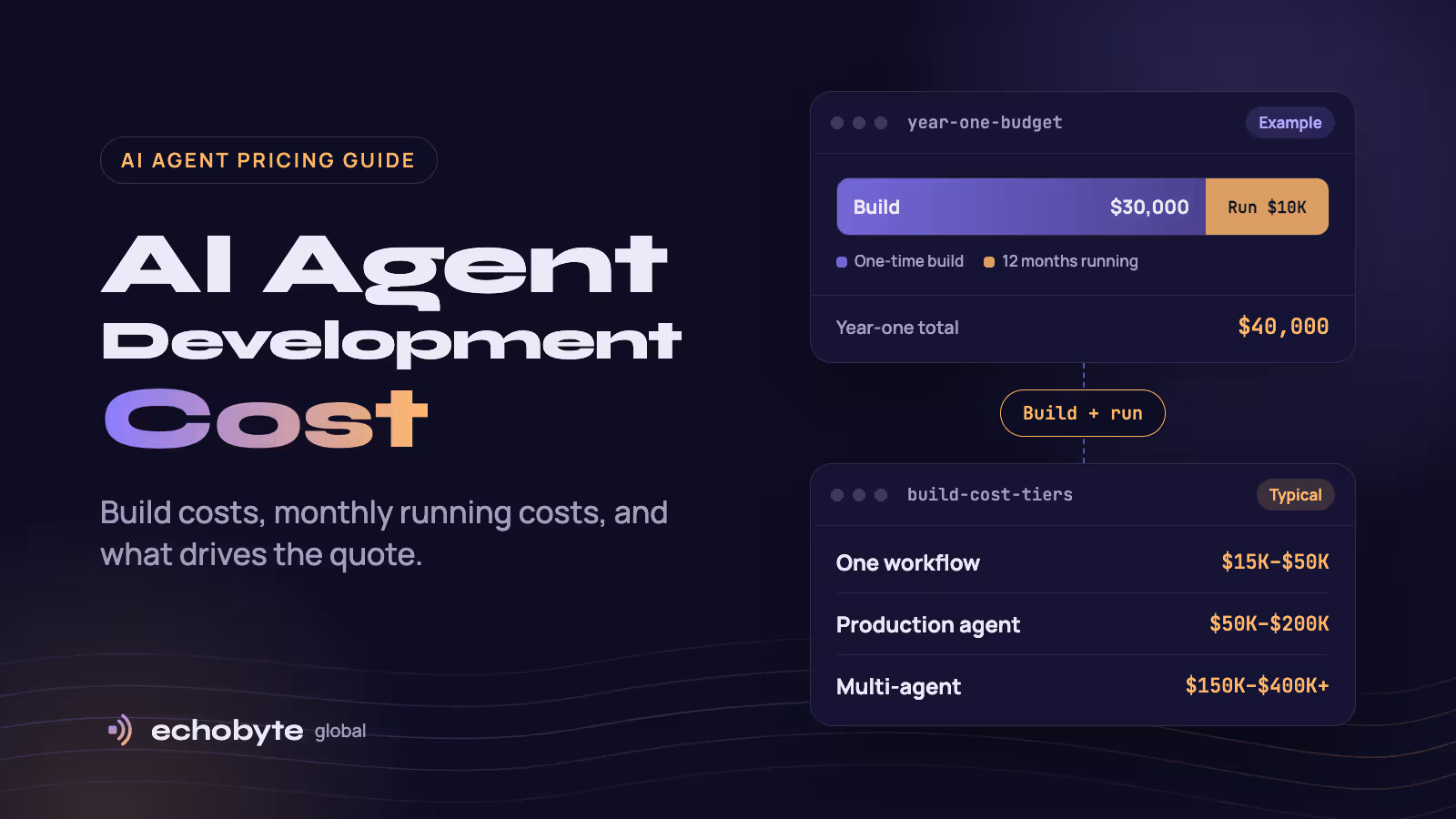
A single-workflow AI Agent Development Costs about $15,000 to $50,000 to build. A production agent with several integrations costs $50,000 to $200,000, and multi-agent enterprise systems run $150,000 to $400,000 or more. Running one adds roughly a quarter to a third of the build cost in the first year, or about $500 to $13,000 a month depending on volume. Published guides span $5,000 to over $400,000 because they price different kinds of agent.
We compared five 2026 cost guides and added what most of them leave out: what ready-made agents charge per resolution, when buying beats building, and a payback example. We build AI agents and automation as part of our custom software work, so we also show how we scope them. Prices were checked in October 2026.
Key takeaways
- A first, single-workflow agent usually costs $15,000 to $50,000. Costs climb with autonomy, the number of systems it touches and compliance needs.
- Budget for running costs from day one. Guides put them at about 25% to 35% of the build cost in year one, and model fees are often the smaller part.
- Ready-made agents charge per outcome, from about $0.50 to $2.00 per resolved or handled conversation. At low volume, buying is usually cheaper than building.
- Start with the lowest autonomy that solves the problem. An agent that suggests, or acts after a person approves, costs far less than one acting alone.
- Gartner forecasts that over 40% of agentic AI projects will be canceled by the end of 2027, citing cost, unclear value and weak risk controls. Scope narrowly and measure.
What is an AI agent, and how is it different from a chatbot?
An AI agent is software that uses a language model to pursue a goal. It decides what to do next, calls tools such as your CRM, email or database, and escalates to a person when it is unsure. A chatbot only answers questions. A workflow tool such as Zapier, Make or n8n follows fixed rules.
That difference drives the price. A chatbot needs a prompt and a knowledge base. An agent also needs orchestration logic, integrations, memory, testing of its decisions and monitoring. If fixed rules can do the job reliably, a workflow tool is cheaper and more predictable. An agent earns its cost where inputs vary and decisions need judgment.
How much does it cost to build an AI agent?
Cost follows how much the agent decides on its own. These ranges combine four 2026 guides from SolGuruz, RaftLabs, Azilen and Biz4Group. They are agency price lists, not studies.
| Type of agent | Typical build cost | Typical timeline | What it does |
|---|---|---|---|
| Recommends only, or acts after a person approves | $5,000 to $15,000 | 6 to 12 weeks | Suggests answers or actions, and a human confirms |
| Single-workflow agent acting within set limits | $15,000 to $50,000 | 4 to 8 weeks | One workflow, one or two integrations, escalates unusual cases |
| Production agent with 3 to 5 integrations, memory, monitoring | $50,000 to $200,000 | 3 to 5 months | Handles edge cases, logs decisions, connects to real business systems |
| Multi-agent system | $150,000 to $400,000+ | 6 to 12 months | Several specialized agents coordinated into one workflow |
Voice adds cost. SolGuruz puts a voice agent $10,000 to $25,000 above a comparable text agent, while RaftLabs prices full voice agents at $50,000 to $150,000 because of real-time speech processing.
Why do AI agent cost guides disagree?
They describe different projects and count different costs. Here is what five guides say.
| Guide | Stated range | What stands out |
|---|---|---|
| SolGuruz (September 2026) | $5,000 to $200,000+ | Prices by autonomy level, and separates build from 12-month running cost |
| Azilen (September 2026) | $10,000 to $400,000+ | Enterprise focus, with a monthly operating cost of $3,200 to $13,000 |
| RaftLabs (December 2025) | $15,000 to $400,000 | Prices each integration at $8,000 to $30,000 |
| Biz4Group (November 2025) | $20,000 to $60,000 | Narrower band for small to mid-size projects |
| Leanware (October 2026) | No standard build range | Says agency ranges are price lists, and that cost depends on your process |
Five things explain the gap:
- What counts as an agent. A support chatbot and a multi-agent system share a name but not a price.
- Build only or build plus run. Some guides quote only the build. Others add monthly operating costs.
- Where the team is. SolGuruz lists senior AI engineers at under $25 to $45 an hour in India and $80 to $150 in the US.
- How many systems it touches. RaftLabs says each integration adds $8,000 to $30,000.
- Age. Models, tools and prices move quickly, and two of these guides are nearly a year old.
Before you compare quotes, compare what each one assumes.
Where does the build budget go?
Most of the money goes into integrations, agent logic and testing, not the model. Combining the component breakdowns from Azilen and RaftLabs:
| Component | What it covers | Typical cost |
|---|---|---|
| Discovery and design | Mapping the workflow, systems, risks and success measures | $5,000 to $20,000 |
| Agent logic and orchestration | Deciding steps, tool use, fallbacks and escalation | $15,000 to $80,000 |
| Knowledge and retrieval | Ingesting your documents, vector search, memory | $15,000 to $50,000 |
| System integrations | CRM, ERP, helpdesk, email, databases | $8,000 to $30,000 each |
| Evaluation and testing | Test cases, scoring, safety checks, edge cases | $5,000 to $20,000 |
| Deployment, monitoring and admin screens | Logging, alerts, review queues, cost limits | $5,000 to $30,000 |
Evaluation is the line most often skipped. Without it, mistakes reach customers first.
What drives AI agent cost?
Six factors move the price most:
- Autonomy. An agent that acts alone needs permissions, rollback, exception handling and monitoring that a suggest-only agent does not.
- Number of systems. Every system the agent reads from or writes to needs authentication, data mapping and failure handling.
- Data readiness. Messy or scattered documents add cleanup before the agent is useful.
- Volume. Model usage scales with how often the agent runs, not with how clever it is.
- Compliance. Healthcare, finance and other regulated work add audit trails and review steps.
- Who builds it. Rates differ widely by region.
| Market | Senior AI engineer rate (per hour) | Same 400-hour build |
|---|---|---|
| India | Under $25 to $45 | $10,000 to $18,000 |
| Europe | $65 to $100 | $26,000 to $40,000 |
| USA | $80 to $150 | $32,000 to $60,000 |
These are SolGuruz’s indicative figures for engineering hours only. Actual quotes also include discovery, testing and deployment.
How much does it cost to run an AI agent each month?
Expect roughly $1,500 to $13,000 a month for a production agent, and less for a small internal one. RaftLabs puts post-launch costs at $1,500 to $8,000 a month, and Azilen at $3,200 to $13,000. SolGuruz says $500 to $5,000, or 25% to 35% of the build cost in year one.
| Cost line | What it covers | Typical monthly range |
|---|---|---|
| Model usage | Tokens for every prompt, retry and tool call | $50 to $5,000+, growing with volume |
| Hosting and retrieval | Servers, vector database, storage | $100 to $2,500 |
| Monitoring and logging | Traces, alerts, cost controls | $200 to $1,000 |
| Maintenance and tuning | Prompt updates, new edge cases, API changes | $1,000 to $5,000 |
| Security and access upkeep | Permissions, audit trails | $500 to $2,000 |
| Human review of exceptions | Staff checking cases the agent flags | Your team’s time, often the biggest line |
Model fees are often smaller than people expect. In a McKinsey banking example reported by Leanware, tokens made up roughly 20% to 25% of variable running costs, and human oversight made up 70% to 75%. You can estimate your own token bill from monthly runs, model calls per run and tokens per call. Take 5,000 runs a month, four calls per run, 2,000 input and 500 output tokens per call, at $1 and $5 per million tokens. That is about $90 a month in model fees, before everything else in the table.
Do not assume running costs fall. Gartner forecast in August 2026 that inference costs per agentic workflow will rise more than fivefold through 2028, because multi-step agents use far more tokens than a simple chat.
Like any software, an agent also needs yearly upkeep. Our app development cost guide explains the 15% to 20% a year rule of thumb for apps.
Should you build an AI agent or buy one?
Buy first if a ready-made agent covers your use case. Many vendors charge only when the agent does the work. Published prices checked in 2026:
| Option | Published price | Notes |
|---|---|---|
| HubSpot Customer Agent | About $0.50 per resolution | Switched from per-conversation pricing in April 2026 |
| Intercom Fin | $0.99 per resolution | A 50-outcome monthly minimum applies outside Intercom’s helpdesk |
| Zendesk AI Agents | About $1.50 per automated resolution | Helpdesk plan billed separately |
| Salesforce Agentforce | $2.00 per conversation | Charged whether or not the issue is resolved |
| Self-serve platforms (e.g. Gumloop) | From about $37 a month | You configure and maintain the workflow |
Vendors change these prices often, so confirm them before you decide.
Here is an illustration. Say a support team gets 4,000 tickets a month and an agent resolves 70% of them, or 2,800. At $0.99 each, a per-resolution vendor would cost about $2,770 a month, or $33,000 a year. A custom agent for the same work might cost $30,000 to build and about $10,000 to run in year one, which is $40,000. The vendor is cheaper in year one. From year two, the custom agent costs about $10,000 against roughly $33,000, if it performs as well and the vendor does not change its prices.
As a rule of thumb, Leanware suggests a platform when total automation spend is under about $1,500 a month or the workflow sits in one system. A custom agent fits better when it spans four or more systems or carries compliance needs a vendor’s terms cannot meet.
Is an AI agent worth the cost?
It pays back when the work is frequent, repetitive and the exceptions are manageable. Use this test:
Annual saving = hours saved per week × 52 × hourly cost.
An illustrative example. A team spends 25 hours a week on a task at $35 an hour, which is $45,500 a year. The agent handles 60% of it, saving $27,300. Year one costs $30,000 to build plus about $10,000 to run, so you are $12,700 behind. In year two you save $27,300 and spend about $10,000, a net $17,300. The agent pays back around month 21.
Model 60% to 80% of the theoretical saving, because an agent rarely removes a task entirely. Also count the cost of mistakes, review time and rework. A second agent is usually cheaper than the first, because SolGuruz notes that authentication, logging and evaluation can be reused.
What hidden costs do AI agent quotes leave out?
Six costs usually land on your side of the invoice:
- Your team’s review hours, especially in the first months.
- Model changes. Providers retire models, and prompts need retesting.
- Cleaning up wrong actions. An agent with write access will occasionally write the wrong thing.
- Upstream plan upgrades, because agents make far more API calls than people.
- Change management. Staff need to know what the agent handles and when to override it.
- Compliance evidence, which is ongoing in regulated industries.
SolGuruz suggests adding 15% to 25% to a vendor number before taking it to finance.
How can you lower AI agent development cost?
- Start narrow. One workflow that costs your team 10 or more hours a week is a better first agent than a general assistant.
- Start with low autonomy. Let the agent suggest, or act after approval, before it acts alone.
- Use proven frameworks and managed models, instead of building orchestration or hosting your own.
- Build evaluation in from day one, because fixing silent errors later costs more.
- Cap model usage. Set token budgets and iteration limits so a runaway loop cannot run up a bill overnight.
- Prototype first. A clickable prototype of the approval screens and handoffs exposes problems before code. Our UI/UX design team builds these in Figma.
If you are also deciding what to build first, our MVP development guide covers how to cut a feature list down to the version worth testing.
How do you compare AI agent quotes?
Ask every vendor the same questions:
- Which autonomy level is this quoted at, and what changes the price at the next level?
- What can the agent do without a human, and which systems can it write to?
- What monthly running cost are you assuming, and at what volume?
- What happens to the price if volume doubles?
- Is testing of the agent’s decisions in the quote?
- Who owns the code, prompts and accounts after launch?
- Is this a pilot price or a production price?
Watch for these red flags:
- No discovery phase. A quote without one is based on assumptions about your systems.
- No evaluation line. If testing is not priced, it will not happen.
- A build price with no running-cost estimate. Ask for a 12-month total.
- A vague answer on volume. A vendor who cannot say what doubling volume costs is leaving the running bill to you.
How do we scope AI agents at Echobyte?
There is no standard price for an agent, so we start with a discovery workshop to map your workflows and decide what to build first. Our custom software service starts at $8,000 per project and typically takes 8 to 20 weeks. AI agents and automation, meaning LLM features, RAG assistants and automated workflows built over your data, are part of the standard scope.
We scope in phases, agree a fixed quote for each phase and show working software every two weeks. We build with Next.js, Node.js, TypeScript, PostgreSQL and AWS, and connect to OpenAI and Gemini models. You own the code, documentation and cloud accounts. We can also add an agent to a product you already have, or build it as part of a new one. If you are planning a subscription product, see our SaaS development cost guide.
An agent is only worth running if you can see what it does. Our analytics service sets up tracking and dashboards for resolution rate, escalations and cost per task. And if your goal is to be cited by AI assistants rather than build one, read our AI search optimization guide. See our pricing page for starting prices.
AI agent development cost FAQ
How much does it cost to build an AI agent?
A single-workflow agent typically costs $15,000 to $50,000. A production agent with several integrations costs $50,000 to $200,000, and multi-agent enterprise systems cost $150,000 to $400,000 or more. A read-only agent that only recommends can cost $5,000 to $15,000.
How much does an AI agent cost per month to run?
Production agents commonly run $1,500 to $13,000 a month, covering model usage, hosting, monitoring, maintenance and security. Small internal agents can cost far less. Guides put year-one running costs at about 25% to 35% of the build cost.
Is an AI agent more expensive than a chatbot?
Yes. A chatbot answers questions from a knowledge base. An agent also plans steps, uses tools, remembers context and needs its decisions tested and monitored. Each of those layers adds engineering cost.
How long does it take to build an AI agent?
A single-workflow agent takes about 4 to 8 weeks. A production agent with several integrations takes 3 to 5 months. Multi-agent systems take 6 to 12 months. Integrations, testing and compliance work set the timeline.
Can I build an AI agent for under $10,000?
Yes, if the scope is narrow. A read-only agent that recommends answers can cost $5,000 to $10,000. Costs rise quickly once you add retrieval over your documents, integrations or the ability to act on its own.
How much does an AI voice agent cost?
Voice adds real-time speech recognition and generation. SolGuruz puts it $10,000 to $25,000 above a comparable text agent, while RaftLabs prices full voice agents at $50,000 to $150,000.
Is it cheaper to build an AI agent in India?
Hourly rates are lower. SolGuruz estimates the same 400-hour build at $10,000 to $18,000 in India against $32,000 to $60,000 in the US. Scope, testing and communication still affect the result, so compare what each quote includes.
Are AI agents worth it?
They can be, when the task is frequent and the exceptions are manageable. Model the saving at 60% to 80% of the theoretical figure and include running costs. Gartner expects over 40% of agentic AI projects to be canceled by the end of 2027, so start small and measure.
Thinking about an AI agent for your business? Our team scopes, builds and runs AI agents and automation as part of our custom software service, and every project starts with a free discovery call.
Sources
- AI Agent Development Cost in 2026: Pricing & Cost Breakdown, SolGuruz, September 2026
- AI Agent Development Cost in 2026: The Complete Breakdown, Azilen, September 2026 (updated October 2026)
- AI Agent Development Cost in 2026: What You’ll Actually Pay, RaftLabs, December 2025
- AI Agent Development Cost in 2026: Factors and Examples, Biz4Group, updated November 2025
- How Much Does an AI Agent Cost to Build and Run?, Leanware, October 2026
- AI agent pricing models, Quickchat AI, April 2026
- Intercom Fin AI Review 2026: Pricing, Limits & Alternatives, SiteGPT, June 2026
- Gartner predicts over 40% of agentic AI projects will be canceled by end of 2027, Gartner, June 2025