On this page
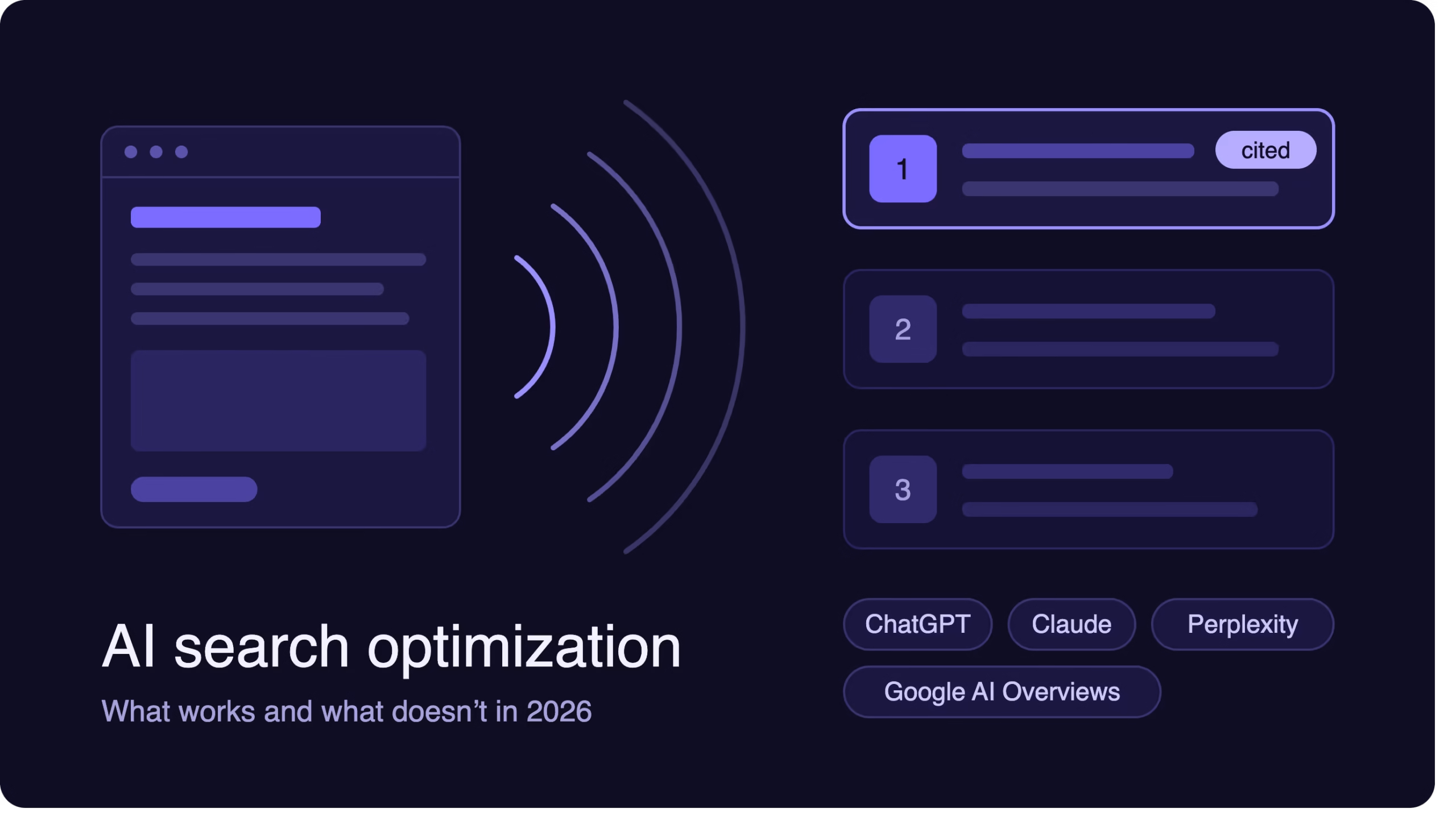
AI search optimization is the work of making your website easy for AI tools like Google’s AI Overviews, ChatGPT, Claude and Perplexity to find, understand and cite. For Google, that work is still ordinary SEO. For other assistants it adds a few steps: let their search crawlers in, keep your key pages fresh, and get talked about beyond your own site.
That is a plainer answer than most guides give, and Google backs it. In a guide last updated on July 10, 2026, Google says its AI features are built on its core ranking systems, then lists popular AI tactics you can skip. Separately, an Ahrefs analysis of 75,000 brands shows what tends to go with showing up in ChatGPT. This guide puts both side by side, rates every tactic by how strong the evidence is, and ends with an eight-step checklist you can work through in an afternoon.
What is AI search optimization?
AI search optimization, also called AI search engine optimization or AI SEO, is improving your website, content and brand so AI-powered search tools include and cite you in their answers. It covers Google’s AI Overviews and AI Mode, plus assistants with built-in web search such as ChatGPT, Claude and Perplexity.
Two other labels describe the same work:
| Term | Stands for | Meaning |
|---|---|---|
| AEO | Answer engine optimization | Improving how often AI-generated answers include you |
| GEO | Generative engine optimization | The same goal under a different name |
Google’s guide defines both terms and says that, from Google Search’s point of view, optimizing for generative AI search is still SEO.
Is AI search optimization different from SEO?
For Google, no. For other AI assistants, partly. Google’s AI features pull pages from the same Search index and use the same ranking and quality systems. Google names two techniques behind them. Retrieval-augmented generation fetches relevant pages from the index and writes an answer grounded in them. Query fan-out runs several related searches at once. In Google’s own example, a question about fixing a weedy lawn can trigger side searches for weed killers, chemical-free removal and prevention.
Other assistants are less predictable. SparkToro tested brand recommendations and found that asking ChatGPT the same question 100 times almost never returns the same list of brands twice. You can’t hold a #1 spot in ChatGPT the way you can on Google. The realistic goal is visibility: showing up in a growing share of relevant answers.
| Google AI Overviews and AI Mode | ChatGPT, Claude and other assistants | |
|---|---|---|
| Where sources come from | Google’s Search index | Their own search crawlers, plus pages fetched live when someone asks |
| Do AI-specific files help? | Google says no | Little public evidence so far |
| Are there stable rankings? | Yes | No, answers change from run to run |
| How to measure | Generative AI performance report in Search Console | Referral traffic, server logs and repeated test questions |
What actually works in AI search optimization?
The best-supported tactics are the ones Google, OpenAI and Anthropic document themselves. Third-party data backs a few more, and the rest is unproven. Here is how we rate them.
| Tactic | Evidence | What the source says |
|---|---|---|
| Get pages indexed and snippet-eligible | Confirmed by Google | A page must be indexed and eligible to show with a snippet to appear in Google’s AI features. |
| Publish content only you can write | Confirmed by Google | Google says unique, first-hand content will likely matter more than any other tip in its guide. |
| Let AI search crawlers in | Confirmed by OpenAI and Anthropic | Search crawlers are what let assistants surface and link to your site. |
| Fix the technical basics | Confirmed by Google | Crawlable pages, good page experience, sound JavaScript SEO and fewer duplicates all still apply. |
| Keep business and product details accurate | Confirmed by Google | AI responses can include local businesses and products, and Business Profiles and Merchant Center feeds help. |
| Answer early on the page | Third-party data | In an analysis of 1.2 million ChatGPT citations, 44.2% came from the first 30% of a page. |
| Update important pages | Third-party data | Across 17 million citations, AI assistants favored content 25.7% fresher than organic results. |
| Earn real brand mentions | Third-party data | YouTube mentions had the strongest link with ChatGPT visibility among the factors Ahrefs tested. |
| llms.txt, AI-only schema, chunking | Not supported | Google says none are needed. See the myths below. |
Third-party studies show correlation, not proof. Treat them as hints about where to spend effort, not guarantees.
How to optimize for AI search: 8 steps
1. Make sure Google can index your pages and show snippets
Google says a page must be indexed and eligible to appear with a snippet to show up in its AI features, and that indexing is never guaranteed. In Search Console, run your most important URLs through URL inspection. Check there is no noindex or nosnippet directive, submit your sitemap, and point duplicate pages to one canonical address.
2. Let AI search crawlers in
AI companies run separate crawlers for training, search and live user requests, and you can control each one. The search crawlers are the ones that let assistants link to you.
- OpenAI: OAI-SearchBot surfaces websites in ChatGPT’s search results. GPTBot is a separate setting for whether your content is used to train OpenAI’s models. ChatGPT-User acts when a person asks ChatGPT to look at something, so robots.txt rules may not apply to it. developers.openai.com +2
- Anthropic: Claude-SearchBot indexes content to improve search results, and Anthropic says blocking it may reduce your visibility there. Claude-User fetches a page when someone asks Claude a question that needs live web content, and ClaudeBot is the training crawler. claudeppc
Whether to allow training crawlers is your call. Ahrefs points out that blocking them means AI models learn about you from third-party sites instead of your own.
# AI search crawlers: allow them so assistants can cite you
User-agent: OAI-SearchBot
Allow: /

User-agent: Claude-SearchBot
Allow: /

User-agent: PerplexityBot
Allow: /

# Training crawlers are optional and separate from search visibility.
# Remove the # at the start of each line to opt out.
# User-agent: GPTBot
# Disallow: /
#
# User-agent: ClaudeBot
# Disallow: /
If your robots.txt doesn’t mention these bots, they are allowed by default. The real risk is an accidental block from a plugin, a hosting default or a firewall, and Ahrefs flags Cloudflare’s AI-bot settings as one to check. Bot names change, so confirm them in each company’s documentation. OpenAI says robots.txt changes can take about 24 hours to take effect for search. searchengineworld
3. Put the answer first
Open every page with a direct answer, then explain it. Kevin Indig’s analysis of 1.2 million ChatGPT citations found that 44.2% came from the first 30% of a page, against 24.7% from the last third. That doesn’t mean chopping pages into tiny pieces. Google says there is no need for that. Clear headings and short paragraphs help readers, and what helps readers seems to help AI tools too.
4. Publish what only you can say
Google says generic content, like a “7 tips” list anyone could write, adds little. First-hand content, such as your real prices, project results, mistakes, screenshots and data, is what stands out. Ahrefs notes that ChatGPT tends to cite specific, quantified claims. We try to follow this ourselves. Our llms.txt guide shows our own file and the code that generates it, and our headless WordPress guide describes a bug we hit on our first test.
5. Keep important pages fresh
Ahrefs’ study of 17 million citations across seven AI search platforms found that assistants favor newer content. Update the pages that matter with real changes: current statistics, revised advice, new sections for questions people now ask. Only change the visible date when the page really changed. Ahrefs warns that faking freshness erodes trust.
6. Earn real mentions
AI tools can reflect what the web says about you. In Ahrefs’ data, YouTube mentions had the strongest link with ChatGPT visibility, followed by branded web mentions, and Reddit was the most-cited domain. Google warns that chasing inauthentic mentions is less helpful than it looks. So do the honest version: ask customers for reviews, keep your Google Business Profile complete, answer questions in communities where you have real expertise, and publish original data others want to cite. Our HVAC SEO guide shows how this works for a local business.
7. Cover the technical basics, and make your site easy for AI agents
Put the full article in the HTML your server sends, not behind JavaScript. Google says it can process JavaScript, but that SEO is generally harder on JavaScript frameworks. Our headless WordPress guide lists what to handle yourself on a Next.js site. Keep pages fast and readable on phones, as our mobile-first design guide explains.
Use structured data, such as Organization or LocalBusiness, for what it is built for: rich results and clear business details. Google says its AI features don’t need special markup. Google also notes that browser agents read pages through screenshots, page structure and the accessibility tree, so clear labels, real buttons and semantic HTML help them. Google’s web.dev guide to agent-friendly sites is a good place to start.
8. Measure what you can
- Google: Use the Generative AI performance report in Search Console to see how your pages appear in AI features.
- Other assistants: Look for referral traffic from chatgpt.com and perplexity.ai in your analytics.
- Crawlers: Check your server logs for OAI-SearchBot, Claude-SearchBot and similar names.
- Test questions: Write 10 to 20 questions your customers really ask. Run them monthly and record whether you are mentioned or cited. Run each one a few times, because answers change.
AI search optimization myths to skip
| Myth | What the evidence says |
|---|---|
| You need an llms.txt file | Google says Search ignores it, and an Ahrefs study found 97% of files got no requests in a month. It’s harmless to add, and we publish one, but don’t expect results. |
| You need special schema for AI | Google says no special markup is needed. Structured data still helps with rich results. |
| Break every page into tiny chunks | Google says chunking isn’t required. Write clear pages for your readers. |
| Rewrite your content for AI | Google says AI systems understand synonyms and meaning, so no special writing style is needed. |
| Buy mentions and guest posts at scale | Google says inauthentic mentions are less helpful than they seem. |
| Publish hundreds of pages to cover every prompt | Google treats this as scaled content abuse if done to manipulate results, and Ahrefs found page count has a very low link with ChatGPT visibility. |
| You can rank #1 in ChatGPT | ChatGPT answers vary run to run. Track visibility across many questions instead. |
How long does AI search optimization take?
Expect weeks to months, not days. Because most of the work is SEO, new pages on newer sites follow the same timeline as any SEO work. In its first week, Google Search Console showed our llms.txt guide with 70 impressions and no clicks yet. That is normal for a new page on a new domain, since impressions come before clicks. AI citations are noisier still, so judge progress over a few months, using the same test questions each time.
AI search optimization FAQ
What is AI search optimization?
AI search optimization is improving your website, content and brand so AI tools like Google’s AI Overviews, ChatGPT, Claude and Perplexity find, understand and cite you in their answers. It is also called AI SEO or AI search engine optimization.
Is SEO for AI search different from normal SEO?
For Google, no. Google says its AI features rely on its core ranking and quality systems, so SEO best practices still apply. For other assistants, a few extra steps matter: letting their search crawlers in, keeping pages fresh and earning mentions beyond your site.
What is the difference between AEO and GEO?
AEO stands for answer engine optimization and GEO for generative engine optimization. Both describe work aimed at appearing in AI-generated answers. Google’s guide defines both and calls them SEO from its point of view.
Do I need an llms.txt file?
No, not for Google. Google says Search ignores llms.txt, so it neither helps nor hurts. It may help AI coding tools read developer documentation. Our llms.txt guide covers who reads it.
Does schema markup help me appear in AI answers?
Google says no special schema is needed for its AI features. Structured data is still worth using for rich results and clear business details.
How do I get my business cited by ChatGPT?
Nobody can guarantee a citation, and answers change from run to run. You improve your odds by allowing OAI-SearchBot, writing clear first-hand answers near the top of your pages, keeping them updated and earning real mentions on the sites and communities ChatGPT cites.
Should I block AI crawlers?
Only if you have a reason. Blocking training crawlers like GPTBot or ClaudeBot is a separate choice from blocking search crawlers. Blocking search crawlers like OAI-SearchBot or Claude-SearchBot can reduce your visibility in those assistants’ answers.
How do I track visibility in AI search?
In Google, use the Generative AI performance report in Search Console. For other assistants, check analytics for referrals from chatgpt.com or perplexity.ai, look for crawler names in your server logs, and test a fixed list of 10 to 20 questions every month.
Want help with AI search optimization? Our SEO team works with businesses worldwide, and every project starts with a free discovery call.
Sources
- Optimizing your website for generative AI features on Google Search, Google Search Central, updated 10 July 2026
- Overview of OpenAI crawlers, OpenAI
- Does Anthropic crawl data from the web?, Anthropic
- How to Rank on ChatGPT: What Actually Works, Ahrefs
- Do AI assistants prefer to cite fresh content?, Ahrefs
- The Science of How AI Pays Attention, Kevin Indig
- AI recommendation consistency research, SparkToro