On this page
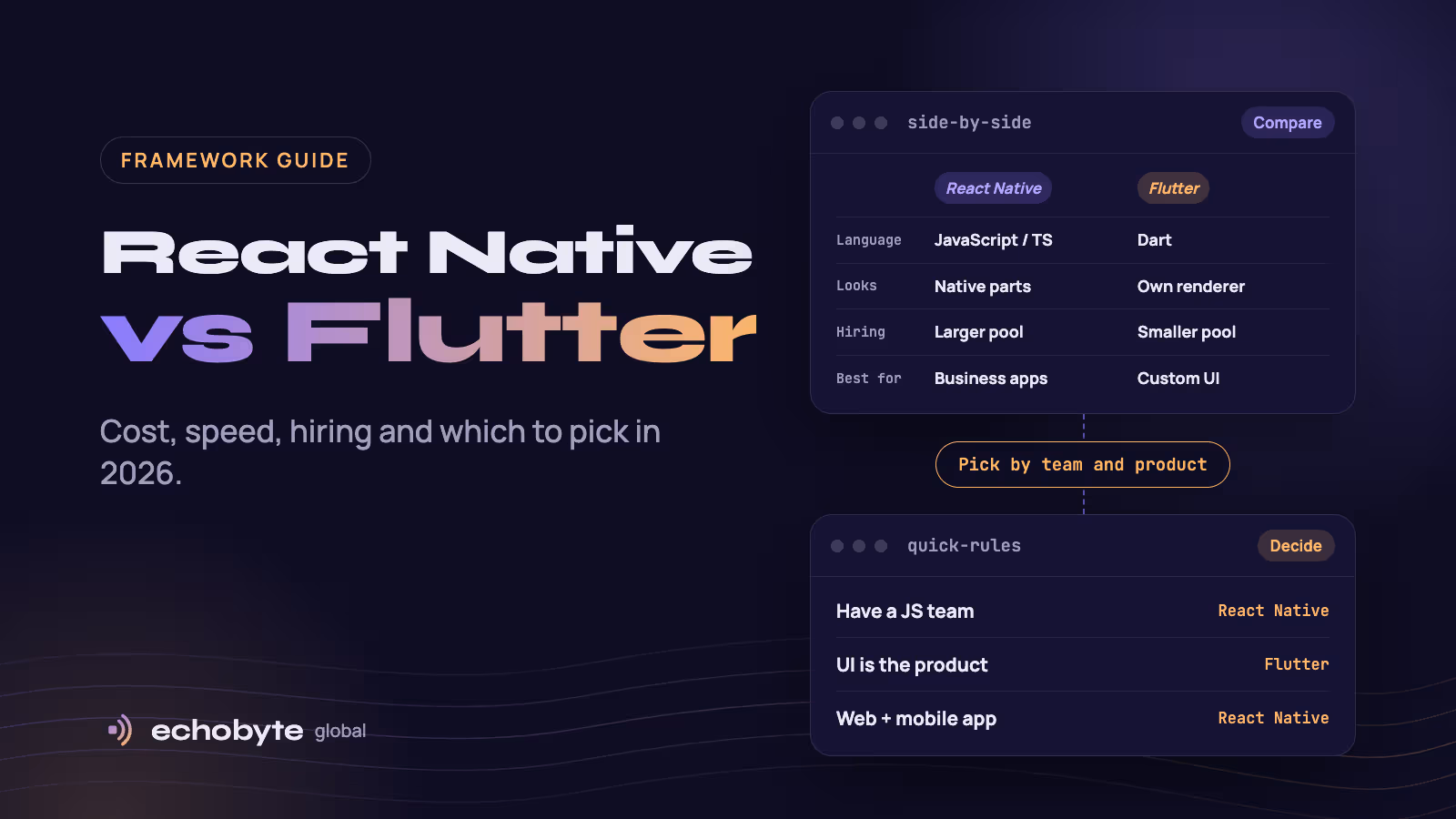
React Native is the better default for most business apps, especially if your team already uses JavaScript or React. Flutter is the better pick when custom UI, rich animation and identical visuals on every device are the product. Both are mature in 2026, and for typical apps such as dashboards, forms, catalogs and booking flows, performance is no longer the deciding factor. Team skills, hiring, design needs and code sharing with your web app are.
We build iPhone and Android apps with React Native, so we have a view. We explain where we would choose Flutter instead, and where published guides disagree. Prices and figures were checked in October 2026.
Key takeaways
- Choose React Native if you have JavaScript or TypeScript developers, a React web app or a tight hiring pool.
- Choose Flutter if the interface itself is your product and you want pixel-identical screens on iOS and Android.
- For standard business apps the performance gap is small. Flutter pulls ahead in animation-heavy, custom-drawn interfaces.
- Developer rates are close, but ramp-up time and hiring speed differ, and they drive real cost.
- Switching later means rewriting the mobile app, so decide before you build.
How do React Native and Flutter differ?
React Native draws your screens with each platform’s own components. Flutter draws every pixel itself with its own engine. React Native is maintained by Meta and uses JavaScript or TypeScript. Flutter is maintained by Google and uses Dart.
| React Native | Flutter | |
|---|---|---|
| Language | JavaScript or TypeScript | Dart |
| How screens render | Native platform components | Flutter’s own engine (Impeller) |
| Look and feel | Follows iOS and Android conventions by default | Identical on both unless you adapt it |
| App size | A few megabytes lighter | Carries its engine, about 4 to 8 MB larger |
| Package ecosystem | npm, with over 1.8 million packages | pub.dev, with about 33,000 packages |
| Web and desktop | Web is secondary, with Windows and macOS support from Microsoft | One codebase can target iOS, Android, web and desktop |
| Sharing code with a React web app | High for logic and utilities | Low |
| Used by | Meta, Shopify, Microsoft, Discord, Coinbase, Bloomberg, Walmart | Google Pay, BMW, Alibaba, Nubank |
The package counts come from Leanware. The npm figure covers every JavaScript package, not only mobile ones, so treat it as a rough scale rather than a like-for-like comparison.
What changed in 2026?
Both frameworks fixed their biggest historical weaknesses. According to 2026 guides, React Native’s New Architecture (JSI, Fabric and TurboModules, running on the Hermes engine) is now the default and replaces the old asynchronous bridge. One guide says it became the default in version 0.76 and is bridgeless from 0.82. Flutter’s Impeller engine replaced Skia and removed most shader-compilation jank, and is enabled by default on iOS and on newer Android versions.
If your last impression of React Native came from before 2024, it is worth revisiting. In 2026, “React Native” for a new project effectively means React Native with Expo, which gives you build services and over-the-air updates for bug fixes without waiting for store review.
Is Flutter faster than React Native?
Flutter is faster at rendering complex, animation-heavy screens. For standard business apps the difference is hard to notice. Guides disagree on the details, which is a sign that the numbers depend on the test.
| Measure | What guides say |
|---|---|
| Animation-heavy screens | One guide measures about 58 to 60 FPS for Flutter and about 51 for React Native. Another puts React Native at 45 to 50 FPS under heavy load |
| Cold start | iLab says React Native starts about 200 ms faster. Leanware says Flutter has a slight edge. Another guide measures about 250 ms for Flutter and 300 ms for React Native |
| App size | Flutter apps are typically 4 to 8 MB larger because they bundle the engine |
| Standard business screens | Leanware and QServices both say the difference is minimal for dashboards, forms, lists and catalogs |
The sources are iLab, Leanware and QServices. Their tests use different devices and apps, so do not take any single number as a promise.
The practical rule: if your app is a game-like interface, a data-visualization tool or a heavily animated brand experience, Flutter is easier to keep smooth. If it needs deep integration with native SDKs such as Bluetooth, camera or payments, React Native’s native component model is often easier to work with. If you are building a typical business app, pick on other grounds.
Which costs less to build?
The framework itself rarely sets the price. Your team’s skills and hiring market do. Guides give conflicting numbers:
| Source | What it says |
|---|---|
| iLab | React Native is typically 15% to 25% cheaper at the MVP stage |
| QServices | Hourly rates are nearly identical, and the real gap is ramp-up time |
| ZTABS (2026) | Gives the same $80,000 to $180,000 range and 4 to 6 months for both |
QServices lists mid-level cross-platform rates of roughly $95 to $130 an hour for React Native and $90 to $125 for Flutter in the US and Canada, $40 to $65 and $35 to $60 in Eastern Europe, and $20 to $35 and $18 to $30 in South Asia. The same guide says a JavaScript developer becomes productive in React Native in about 3 to 4 weeks, while learning Dart takes 4 to 8 weeks. On a 2,000-hour MVP that ramp-up can add about $8,000 to $25,000 if your team starts from scratch with Flutter.
Maintenance matters too. React Native depends on community packages, so QServices suggests planning roughly 10% to 15% of the annual development budget for dependency and platform updates. iLab and Leanware argue Flutter’s more cohesive ecosystem can make it cheaper to maintain over two to three years. Our app development cost guide covers the 15% to 20% a year rule of thumb for upkeep.
Which is easier to hire for?
React Native, in most markets. Leanware estimates JavaScript developers outnumber Dart developers by roughly 20 to 1, and iLab puts the React Native pool at two to three times Flutter’s. Softomate reports about 3.4 times as many React Native job postings in the UK in April 2026, and Techsy reports about six times as many in the US.
Surveys of what developers use tell a different story. Leanware cites Flutter at about 46% of cross-platform usage against React Native at about 35%, so Flutter is not a niche choice. Rates between the two are close, though one guide reports Flutter developers costing 20% to 30% more where the pool is thin. If you plan to hire locally or scale a team quickly, check how many candidates you can actually find in your market before you commit.
What about web, desktop and sharing code?
If you already have a React web app, React Native can share business logic with it: types, validation, API calls and state management. Leanware says up to 80% of non-UI code can be shared in a monorepo, though you do not share the interface itself. Our web work is also React and TypeScript, so the same team can cover both.
Flutter targets iOS, Android, web, Windows, macOS and Linux from one codebase, which is attractive for kiosks or desktop companions. Flutter web is a good fit for app-like experiences and internal tools, but it draws to a canvas, so Leanware says it is not ideal for content sites that depend on SEO. If a public website matters for search, build it separately. Our web development service builds fast, SEO-ready sites on Next.js.
Which apps suit which framework?
| Your situation | Likely pick | Why |
|---|---|---|
| Startup with a JavaScript or React team | React Native | Faster hiring and shared web logic |
| SaaS with a web app and a mobile companion | React Native | Reuse logic between the React web app and the mobile app |
| Standard business app (forms, lists, dashboards, bookings) | React Native | Native feel and a large talent pool |
| Brand-critical consumer app with rich animation | Flutter | Full control of every pixel and consistent visuals |
| Fintech with complex custom charts or gestures | Flutter | Reliable rendering for custom interfaces |
| Mobile and desktop from one codebase | Flutter | One codebase for all targets |
| Deep native SDK or hardware integration | React Native | Easier native module integration |
What about Expo, native and Kotlin Multiplatform?
- Expo. It is the usual starting point for a new React Native app, with managed builds, over-the-air updates and a large module library. You can still add custom native code when you need it.
- Fully native (Swift and Kotlin). Worth it when you need the newest platform features on day one, heavy graphics, or hardware-level control. It means two codebases, which costs more and takes longer. Our MVP development guide explains why most first versions start cross-platform.
- Kotlin Multiplatform. It shares business logic across platforms and typically keeps native screens, so it is closer to native than to Flutter. We do not cover it in depth here.
What are the risks?
- Lock-in. React Native and Flutter do not share code. Moving later means rebuilding the mobile app, so choose first.
- Library lag. React Native apps rely on community packages, and some may trail platform or architecture updates.
- Dart and Google. Flutter depends on a language used mostly inside Flutter, and on Google’s continued investment. Both frameworks are backed by large companies and widely deployed, so neither is a risky bet today.
- Design drift. Flutter does not automatically adopt new platform design patterns, and React Native may need extra work to look identical on both platforms.
How do you decide in an hour?
- Who will build and maintain it? If your developers know JavaScript or TypeScript, lean React Native.
- Is the interface the product? If custom animation and branded visuals are the point, lean Flutter.
- Do you have a React web app? If yes, React Native saves real effort.
- How easy is hiring in your market? Count candidates for each before you decide.
- Do you need web or desktop from the same code? If yes, look hard at Flutter.
- Does it need deep hardware or native SDKs? If yes, lean React Native, or go native.
If the answers split, build a small prototype of your trickiest screen in each framework. A day or two of work will tell you more than any benchmark.
How do we build apps at Echobyte?
We build iOS and Android apps from a single React Native codebase, using Expo, TypeScript, Node.js, Firebase and Supabase, with Figma for design. A first version typically takes 10 to 16 weeks. Our mobile app development service starts from $8,000 per project and follows four steps: scope the first version, design and prototype, build in two-week sprints with test builds on your own phone, then release and iterate. We handle App Store and Google Play submission.
React Native fits how we work because our web projects are also React and TypeScript. If your interface is the product and you need pixel-identical, heavily animated screens, we would tell you Flutter may fit better and help you decide. If you are building a subscription product with both web and mobile, see our SaaS development cost guide and custom software service. Our UI/UX design team prototypes screens before any code is written. See our pricing page for starting prices.
React Native vs Flutter FAQ
Which is better, React Native or Flutter?
Neither wins everywhere. React Native is the better default for business apps and teams that know JavaScript. Flutter is better when custom UI, animation and visual consistency are central to the product.
Is Flutter faster than React Native?
For animation-heavy and custom-drawn interfaces, yes. For standard business apps the difference is minimal, and guides disagree on startup times and frame rates.
Which is cheaper, React Native or Flutter?
Hourly rates are close. React Native is often cheaper at the start because the hiring pool is larger and JavaScript developers ramp up faster. Flutter can be cheaper to maintain in some cases. Your team’s skills matter more than the framework.
Which has more developers and jobs?
React Native has more developers and job postings, particularly in North America and the UK. Flutter leads in some surveys of what cross-platform developers use.
Is React Native dying?
No. Meta continues to invest in it, the New Architecture is now the default, and companies such as Shopify, Discord, Coinbase and Microsoft use it in production.
Is Flutter good for websites?
It works for app-like web experiences and internal tools. It is not ideal for content sites that rely on SEO, because it renders to a canvas instead of HTML.
Can I switch later?
Technically yes, but the two frameworks do not share code, so you would rebuild the mobile app. Decide before you start.
Which should a startup choose?
If you have JavaScript developers, a React web app or a tight budget, choose React Native. If a distinctive, animation-rich interface is your main differentiator, choose Flutter.
Planning an app? We scope, design, build and launch iOS and Android apps, and every project starts with a free discovery call and a fixed quote.
Sources
- React Native vs Flutter (2026): Performance, Cost & Scalability, Leanware, February 2026
- React Native vs Flutter: What to Choose for a Cross-Platform App in 2026, iLab, August 2026
- React Native vs Flutter: 5 factors SMBs should weigh in 2026, QServices, March 2026
- React Native vs Flutter in 2026: Which Should You Choose?, DEV Community
- React Native vs Flutter in 2026: The Complete Developer’s Comparison, Techsy, February 2026
- React Native vs Flutter for UK App Development, Softomate Solutions, June 2026
- React Native architecture overview and Flutter Impeller, official documentation