On this page
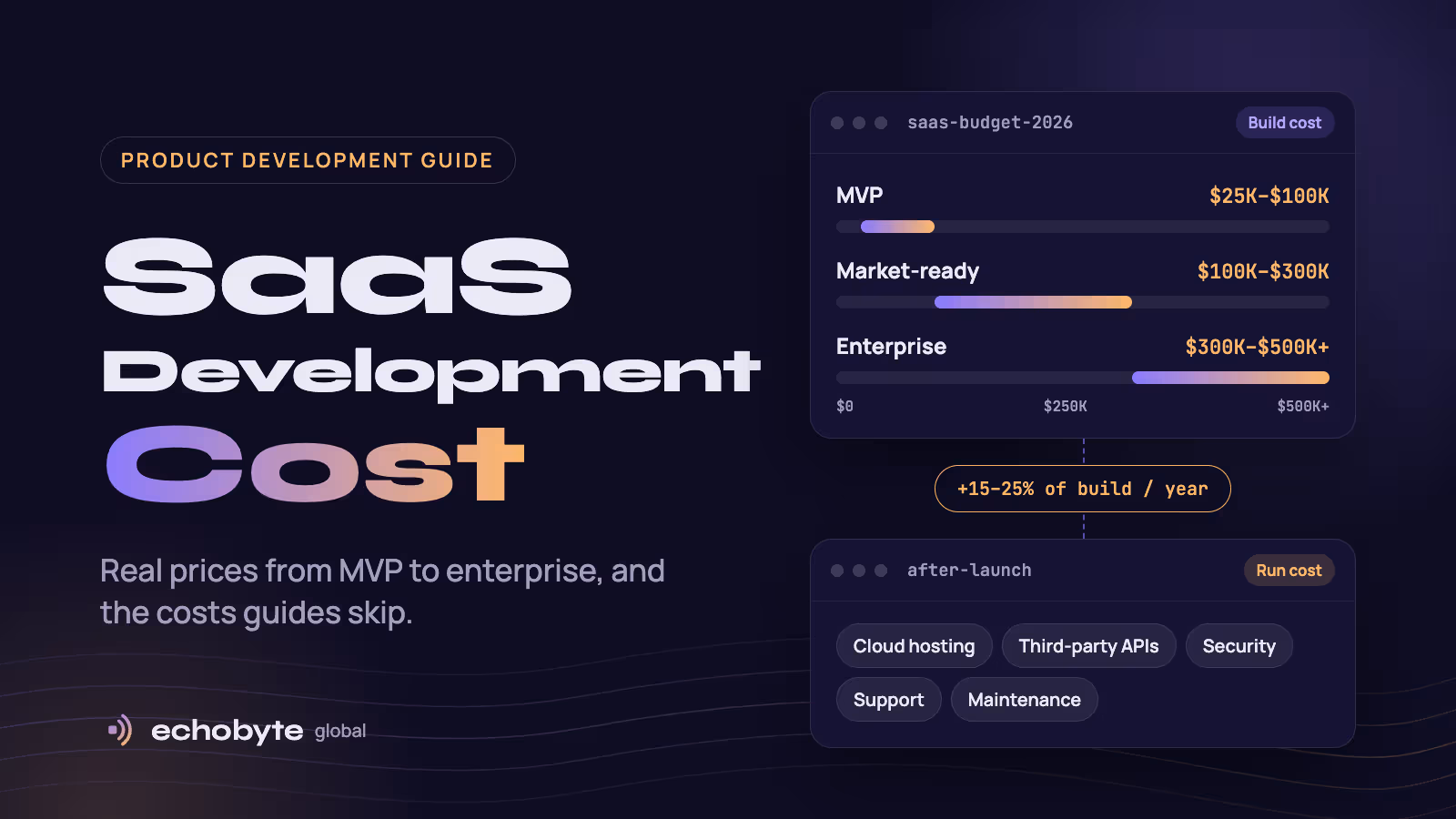
SaaS development costs roughly $25,000 to $100,000 for an MVP, $100,000 to $300,000 for a market-ready product, and $300,000 to $500,000+ for an enterprise-grade platform. Published 2026 guides run from about $15,000 to $500,000+ because they price different products, built by teams in different countries, with different work included. After launch, running the product adds roughly 15% to 25% of the build cost every year.
We compared six 2026 SaaS cost guides and explain why their numbers disagree. Then we break down what drives the price, where the budget goes, what developers charge by region, and which costs most quotes leave out. We build web apps and SaaS products, so we also show how we price them at Echobyte.
Key takeaways
- A production-ready SaaS MVP usually costs $25,000 to $100,000 and takes about 2 to 6 months. Cheaper options exist, but check whether you are buying a working product or a prototype.
- Guides disagree because of scope, team location and what is included. One guide’s MVP has a single user role and no admin panel. Another prices a production-ready product with design, QA, project management and DevOps built in.
- The build is the first bill, not the last. Budget 15% to 25% of the build cost every year for maintenance, cloud, security and support.
- The biggest savings come from scope. Build one core workflow, use ready-made services for sign-in and payments, and run a discovery phase before any code is written.
What counts as SaaS development cost?
SaaS development cost is everything you pay to design, build, launch and run a subscription software product. It splits into three bills, and most guides only price the first.
| Bill | What it covers | When you pay |
|---|---|---|
| Build | Discovery, UI/UX design, front end and back end, billing, testing, launch | Before launch |
| Run | Cloud hosting, third-party services, maintenance, security, support | Every month after launch |
| Grow | SEO, ads, content, onboarding | Before launch and after |
Your first-year budget needs all three. One independent estimator, Project Cost Estimator, suggests setting aside 30% to 40% of the year-one total for marketing, because a product nobody finds earns nothing.
How much does SaaS development cost?
Most SaaS MVPs cost $25,000 to $100,000, market-ready products $100,000 to $300,000, and enterprise-grade platforms $300,000 to $500,000+. These ranges are our summary of the 2026 guides below. They are not a quote.
| Stage | Typical cost | Typical timeline | What you usually get |
|---|---|---|---|
| MVP | $25,000 to $100,000 | 2 to 6 months | One core workflow, sign-in and roles, one payment integration, a basic dashboard |
| Market-ready product | $100,000 to $300,000 | 4 to 10 months | Several user roles, multiple integrations, tiered subscription billing, analytics, admin panel |
| Enterprise-grade platform | $300,000 to $500,000+ | 8 to 12+ months | High-load architecture, compliance work (SOC 2, HIPAA, GDPR), many modules, legacy migration |
Discovery is often priced on its own. Clockwise Software quotes about $12,000 to $25,000 for a discovery phase of 3 to 8 weeks that ends in specs, an architecture decision, a clickable prototype and an estimate. At the other end, a no-code test can cost $2,000 to $10,000, with trade-offs covered below.
Why do SaaS cost guides disagree?
They price different products. Here are six 2026 guides side by side.
| Guide | MVP | Mid-size or growth | Enterprise or full |
|---|---|---|---|
| Clockwise (August 2026) | $50,000 to $100,000 | $100,000 to $250,000+ | $250,000 to $500,000+ |
| Purrweb (August 2026) | $30,000 to $80,000 | $80,000 to $150,000 | $150,000 to $300,000+ |
| Technource (July 2026) | $25,000 to $70,000 | $80,000 to $200,000 | Up to $500,000+ |
| AllStars IT | $25,000 to $80,000 | $80,000 to $300,000 | $300,000+ |
| Azilen (updated October 2026) | $60,000 to $120,000 | $120,000 to $250,000 | $150,000 to $450,000+ |
| Project Cost Estimator (April 2026) | $15,000 to $60,000 | $40,000 to $120,000 | $80,000 to $250,000+ |
Five things explain most of the gap:
- Team location. Azilen says its ranges reflect delivery across North America, Europe and South Africa. Project Cost Estimator assumes a Western freelancer or small agency and says Eastern European teams cost 40% to 55% less. Published developer rates run from $20 to $50 an hour in India to $80 to $150+ in the US.
- What “MVP” means. In Project Cost Estimator’s version, an MVP has a core feature, sign-in, basic billing and one user role, with no admin panel or multi-tenancy. Clockwise says its MVP figures assume production-ready quality and that below roughly $50,000 you are buying a prototype. Same word, different scope.
- What is included. Clockwise’s budgets cover discovery, design, QA, project management and DevOps. Other guides price mainly the build.
- Who is writing. Almost every guide comes from an agency that sells SaaS development, so ranges tend to reflect its own rates and team. Purrweb labels its numbers planning estimates, not quotes.
- Compliance and AI. A product that needs SOC 2, HIPAA or AI features moves up a tier.
Before you compare quotes, compare what each one includes.
What drives SaaS development cost?
Scope, tenancy model, billing, integrations, AI features and team location move the price most.
| Driver | Why it adds cost |
|---|---|
| Scope and user roles | One user type and one workflow is a different job from admins, managers, end users and a billing portal. More roles mean more logic and testing. |
| Tenancy model | Multi-tenant products share infrastructure and are cheaper to run but harder to build. Single-tenant gives each customer an isolated copy and costs more to run. Changing it after launch means re-laying the foundation. |
| Subscription billing | Simple until you add tiers, trials, upgrades, failed-payment retries and tax. |
| Integrations | Every outside system adds authentication, error handling and testing. |
| AI features | Purrweb cites vendor estimates from about $10,000 to $25,000 for a chatbot to $50,000+ for custom machine learning. |
| Design depth | SaaS is dashboard-heavy. More unique screens and a custom design system cost more than a standard component library. |
| Compliance | SOC 2, HIPAA and GDPR add audits, testing and documentation. |
| Team seniority and location | Cheaper, junior-heavy teams can look good on the quote and cost more in rework. |
Founders often count screens, but Clockwise notes that the rules behind the screens drive more of the hours.
What do common SaaS features cost?
Project Cost Estimator prices individual features assuming a senior full-stack developer at $80 to $150 an hour.
| Feature | Typical cost |
|---|---|
| Sign-in, including enterprise SSO | $2,000 to $8,000 |
| Subscription billing (Stripe) | $3,000 to $10,000 |
| Admin dashboard | $5,000 to $15,000 |
| Multi-tenancy | $4,000 to $12,000 |
| Role-based permissions | $2,000 to $6,000 |
| API layer with documentation | $3,000 to $8,000 |
| Analytics dashboard | $3,000 to $10,000 |
Features rarely add up cleanly. The same estimator adds 15% to 20% on top of the sum when sign-in, billing and multi-tenancy have to work together.
Where does a SaaS budget go?
Roughly half to 60% goes to development. The rest pays for the work that makes the code usable. Both guides below call their percentages illustrative, and the mix shifts with scope.
| Stage | Clockwise | Purrweb ($120,000 example) |
|---|---|---|
| Discovery and planning | 5% to 10% | 10% |
| UI/UX design | 10% to 15% | 15% |
| Development | 55% to 60% | 50% |
| QA and testing | 10% to 15% | 15% |
| Project management | 10% to 15% | Not listed |
| DevOps and launch | About 5% | 10% |
Discovery is the smallest line and the one most often skipped. Skipping it does not remove the decisions about scope, tenancy and integrations. It just moves them into the build, where changing them costs more.
What do SaaS developers cost by region?
Hourly rates swing roughly 3x to 5x between the US and offshore teams, but the lowest hourly rate rarely gives the lowest total.
| Region | Agency blended rate (Netguru, via Purrweb) | Developer average (iCoderz) | Offshore estimate (AppSierra) |
|---|---|---|---|
| US and Canada | $100 to $180 | $60 to $150+ | $80 to $150+ |
| Western Europe | $70 to $120 | $50 to $120 | Not listed |
| Eastern Europe | $45 to $85 | $35 to $80 | $30 to $70 |
| India | Not listed | $20 to $50 | $20 to $50 |
| Latin America | Not listed | Not listed | $35 to $75 |
| Philippines | Not listed | Not listed | $20 to $45 |
All figures are USD per hour and blend seniority levels. A junior and a senior developer in the same city can differ by 3x to 4x, and time-zone overlap, rework and management time are not in the hourly rate. Compare fixed quotes for the same scope, not rate cards.
What are the hidden and ongoing costs of a SaaS product?
Plan for 15% to 25% of the build cost every year after launch. Azilen gives that range. Wavect’s benchmark of 24 SaaS products found median annual maintenance of 24% of the build cost in year one, 21% in year two and 26% in year three. For a $50,000 MVP, 15% to 25% is $7,500 to $12,500 a year, or roughly $625 to $1,040 a month.
What that money covers:
- Cloud infrastructure. It grows with users and data. In Flexera’s 2026 survey, respondents estimated that 29% of their cloud infrastructure and platform spend was wasted, so review the bill monthly.
- Third-party services. Payments, email, analytics and AI usage fees recur and scale with customers.
- Maintenance and updates. Fixes, security patches and dependency updates never stop.
- Security and compliance. Audits, penetration tests and certifications where required.
- Support tooling. Help desk, status page and in-app support.
Project Cost Estimator’s monthly run rate for a bootstrapped product, before you pay yourself:
| Category | Per month |
|---|---|
| Infrastructure | $50 to $500 |
| Third-party tools | $100 to $500 |
| Marketing | $200 to $2,000 |
| Support | $0 to $1,500 |
| Maintenance development | $500 to $2,000 |
| Total | $850 to $6,500 |
Funded teams with full-time engineers and paid ads spend far more, which the same estimator puts at $15,000 to $50,000 a month. Our website maintenance cost guide covers the marketing site that sits in front of your product.
Does AI make SaaS cheaper to build in 2026?
A little, on some tasks, but not by enough to rewrite your budget. Clockwise reports about 30% faster delivery on its own projects by using AI across the build. Purrweb says AI may speed up selected tasks but does not prove overall savings without comparable projects. One 2026 estimate from Vasundhara puts savings on complex systems at only 10% to 15%, and notes that AI tool subscriptions cost a team $500 to $2,000 a month.
AI inside your product is a different matter. It adds scope, and inference fees grow with every user. Ask each quote to state what it assumes about AI, in the build and in the product.
How to reduce SaaS development cost without cutting quality
Cutting cost is about not wasting the hours you buy, not buying cheaper hours.
- Run a discovery phase first. It turns an idea into specs, an architecture and an estimate for 5% to 10% of the budget.
- Build one core workflow. Write it as “user does X, system does Y, user gets Z”. If it does not fit in a sentence, the scope is too big. Our MVP development guide shows how to cut the feature list.
- Buy the commodity parts. Use proven services for sign-in, payments and email. Project Cost Estimator says building them yourself adds $20,000 to $50,000.
- Pick a stack your team knows well. Ours is Next.js, React, Node.js, TypeScript and AWS.
- Decide tenancy and billing early. Both are expensive to change once customers are using the product.
- Size the architecture for your next stage. Build for the users you will have this year, not for ten million.
- Test demand before you build. A clickable prototype shown to 20 target customers costs $500 to $2,000 and can save months.
- Hold a contingency. One estimator recommends at least 30%, because billing, permissions and third-party APIs always run long.
Freelancer, agency, in-house or no-code: which costs less?
| Option | Typical cost | Best for | Watch out for |
|---|---|---|---|
| No-code | $2,000 to $10,000 | Testing demand | Monthly fees of $100 to $500, and $15,000 to $40,000 to migrate if you outgrow it |
| Freelancer | Lowest hourly rate | Isolated tasks | A full SaaS needs a coordinated team for billing, tenancy and integrations |
| Agency | $25,000 to $100,000 for an MVP | MVPs, first releases, fast scaling | Less day-to-day control, so ask for weekly demos |
| In-house team | Highest fixed cost: salaries, recruiting, management time | A proven product with a steady roadmap | Slowest to start |
How do you get an accurate SaaS quote?
A quote is only as good as the brief behind it. Send every agency the same information:
- The problem in one sentence, and who has it
- The core workflow, from first click to value
- User roles and what each can do
- Your billing model: flat, per seat or usage-based
- Integrations, especially any API you do not control
- Compliance needs such as GDPR, HIPAA or SOC 2
- Platforms: web only, or iPhone and Android too
- Your launch date and budget range
Watch for these red flags:
- A fixed number before any discovery. A serious team scopes first.
- No mention of QA, DevOps or security. They are real costs, and leaving them out makes a quote look cheaper than it is.
- No running-cost estimate. The build price is half the picture.
- Unclear ownership. You should own the code, designs and accounts once you have paid. At Echobyte, you do.
How do we price SaaS projects at Echobyte?
Every project starts with a free discovery call and ends with a fixed quote, so the price does not change unless the scope does. Our Product package covers web apps, SaaS products and mobile apps, and starts at $8,000.
| Package | From | What it includes |
|---|---|---|
| Product | $8,000 | Discovery and scoping, UI/UX for every screen, web app or iOS and Android app, accounts, payments, admin panel, automated testing and CI/CD, 90 days of support |
That starting price buys a tightly scoped first version. More roles, integrations, custom billing, AI features and compliance raise it, as the guides above show. Our job at the scoping stage is to cut the first version down to one core workflow. You approve designs before we write code, and you see weekly demos on a live staging link. Payments follow milestones: a deposit, a payment at design approval and the balance at launch. After launch, our SEO and paid ads team can help people find what we built. See our pricing page for details.
SaaS development cost FAQ
How much does it cost to build a SaaS product?
Most SaaS MVPs cost $25,000 to $100,000, market-ready products $100,000 to $300,000, and enterprise platforms $300,000 to $500,000+. Where you land depends on scope, team location, billing and integrations, AI features and compliance.
How much does a SaaS MVP cost?
A production-ready SaaS MVP usually costs $25,000 to $100,000. Guides range from $15,000 to $120,000 depending on what they include. A no-code test costs $2,000 to $10,000 and a clickable prototype $500 to $2,000, but neither is a product customers can rely on.
How long does it take to build a SaaS product?
An MVP takes about 2 to 6 months, a market-ready product 4 to 10 months, and an enterprise platform 8 to 12 months or more. A discovery phase adds 3 to 8 weeks up front. The number of integrations and compliance requirements move the timeline more than the feature count.
How much does it cost to run a SaaS product after launch?
Plan for 15% to 25% of the build cost per year. For a $50,000 MVP that is roughly $7,500 to $12,500 a year. One estimator puts a bootstrapped product’s total monthly run rate, including marketing, at $850 to $6,500. Cloud, API and support costs grow with your customer count.
Can I build a SaaS with no-code tools?
Yes, to test demand. No-code MVPs cost about $2,000 to $10,000, with monthly platform fees of $100 to $500. If you outgrow the platform, migrating to custom code can cost $15,000 to $40,000, so move once real customers depend on the product.
Is it cheaper to build a SaaS with an offshore team?
Hourly rates are lower, about $20 to $50 in India against $80 to $150+ in the US. But seniority, rework and time-zone overlap also affect the total. Compare fixed quotes for the same scope instead of hourly rates.
How much should I budget for marketing a new SaaS?
One estimator suggests 30% to 40% of your year-one total. For a $60,000 build, that is $18,000 to $24,000 for content, SEO, ads and community. Marketing compounds slowly, so start before launch.
Does AI make SaaS cheaper to build?
Slightly, and only on some tasks. One 2026 estimate puts savings on complex products at 10% to 15%, and AI tools add monthly subscription costs. AI features inside your product add scope and per-use costs that grow with your users.
Planning a SaaS product? Our custom software and UI/UX design team will scope it with you, cut it down to one core workflow and send a fixed quote after a free discovery call. If you are still validating the idea, start with our MVP development guide and our app development cost guide.
Sources
- SaaS Development Costs, How Much Does It Cost to Build a SaaS Platform, Clockwise Software, August 2026
- How Much Does It Cost to Build a SaaS Product in 2026?, Purrweb, August 2026 (includes Netguru’s regional agency rates and Flexera’s 2026 cloud waste survey)
- SaaS Development Cost in 2026: Full Pricing Breakdown, Technource, July 2026
- How much does it cost to build a SaaS product, AllStars IT
- SaaS Development Cost in 2026: A Guide for Founders and Product Leaders, Azilen, updated October 2026
- Real SaaS Build Costs, From MVP to Scale, Project Cost Estimator, April 2026
- Software maintenance cost benchmark for DACH SaaS, Wavect
- Offshore software development rates, AppSierra
- Cost to Hire a Software Developer in 2026, iCoderz Solutions
- How Much Does Custom Software Development Cost in 2026? After AI, Vasundhara, January 2026