On this page
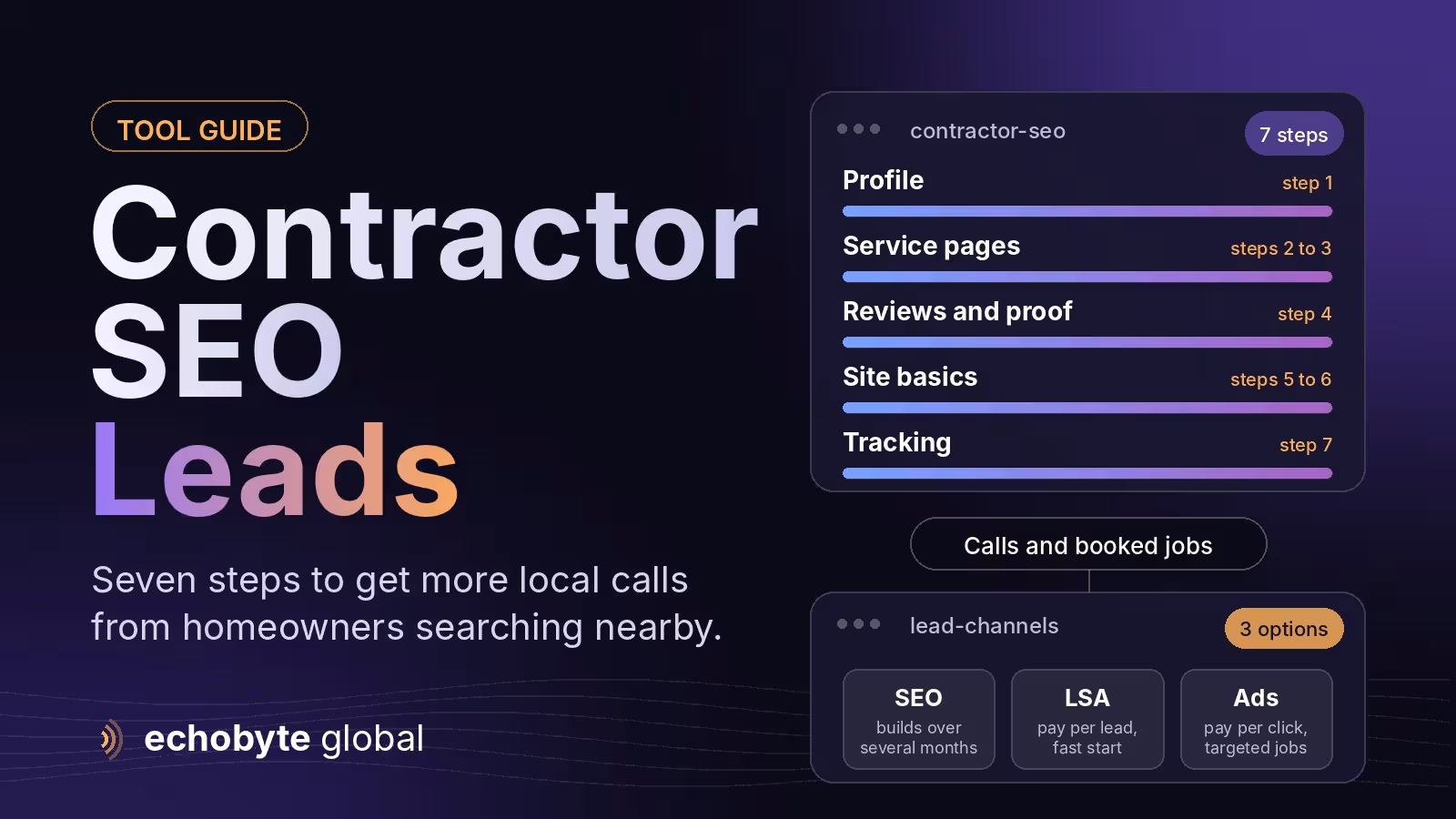
SEO for contractors means getting your business to appear when homeowners search for the work you do, such as “roofing contractor near me” or “kitchen remodel” plus a city, in the map pack, in organic results and increasingly in AI answers. It rests on five things: an accurate Google Business Profile set up as a service-area business, a dedicated page for each service, genuine service-area pages instead of copy-and-paste city pages, a steady flow of reviews, and call tracking so you know which source books jobs. Trust is the deciding factor. BrightLocal’s 2026 survey of 1,002 US consumers found 97% read reviews before choosing a local business, and CallRail reports 98% of consumers search online before hiring a home services business.
This guide covers how homeowners choose a contractor, what the search results page looks like, seven steps to set up local SEO, how it compares with Local Services Ads and Google Ads, a 90-day plan and the mistakes to avoid. Information was checked in November 2026. Statistics come from surveys and vendor reports with different methods, so treat them as direction, not exact values.
Key takeaways
- Homeowners research online and lean heavily on reviews. Your rating, review count and recency often decide who gets the call.
- Contractors who travel to customers should set up their Google Business Profile as a service-area business and hide a home address, per Google’s guidelines.
- Write a dedicated page for each service, and add service-area pages only where you really work and with real local content.
- Google’s spam policy treats near-identical city pages as doorway abuse. Unique, useful pages are safe, and templates with swapped city names are not.
- Track calls and forms by source. SEO is only worth it if it produces booked jobs.
How do homeowners choose a contractor online?
They search, compare ratings and reviews, and call the one that looks trusted. Here is what recent surveys report.
| Finding | Source |
|---|---|
| 98% of consumers search online before hiring a home services business | CallRail home services statistics, 2026 |
| 97% of consumers read reviews when choosing a local business, and 41% always do, up from 29% a year earlier | BrightLocal Local Consumer Review Survey 2026 |
| Many homeowners set a floor on stars and review count, for example 4.5 stars or at least 20 reviews | An analysis of BrightLocal data, so treat it as directional |
| 45% of consumers use ChatGPT or other AI tools for local recommendations | BrightLocal 2026, as reported by agencies |
The practical lesson is that your profile and website have to convince a stranger within seconds, and your reviews do most of that work.
What does the contractor search results page look like?
A search such as “roofing contractor near me” typically shows several layers: Local Services Ads at the top, the map pack, standard organic results and Google Ads. Local Services Ads carry a “Google Guaranteed” badge and charge per lead rather than per click. Organic SEO takes longer, often several months, but it compounds. Many contractors use both, and our Google Ads management pricing guide covers the paid side.
Step 1: How do you set up Google Business Profile as a service-area business?
If you travel to customers and they don’t visit your location, hide your address and list the areas you serve. Google’s guidelines say service-area businesses should hide their address from customers and use one profile for a central location. Showing a home address you don’t serve customers from is a common reason for suspension.
- Choose the most specific primary category for your main trade, then add secondary categories for other services.
- List only areas you really serve. Google’s June 2025 guidance prohibits adding countries or states as service areas.
- Use your real business name, with no keywords or cities added.
- Add real photos of finished work, your team and your vehicles.
- List every service with a description, and keep hours accurate.
Our Google Business Profile optimization checklist covers all 25 steps.
Step 2: Why does every service need its own page?
Local SEO experts rate a dedicated page for each main service highly for organic local results, and homeowners want details before they call. A good service page answers the questions people have at that stage.
| Service page element | What to include |
|---|---|
| Title and H1 | The service plus your main area, for example “Kitchen remodeling in Austin” |
| What’s included | Scope, materials, process and typical timeline |
| Proof | Real project photos, before-and-after images and a short case study |
| Trust | Licenses, insurance, warranty and certifications |
| Pricing guidance | Honest ranges or what affects the price |
| FAQs | Permits, disruption, financing and scheduling |
| Next step | A click-to-call button and a short quote form |
Create separate pages for distinct jobs, such as roof repair, roof replacement and storm damage, instead of one page that tries to cover everything.
Step 3: How do you build service-area pages without doorway risk?
Add a page for an area only if you work there and can say something specific about it. Google’s spam policies, last updated in May 2026, describe doorway abuse as pages created to rank for similar queries that lead users to an intermediate page. Many near-identical pages that differ only by city name are a classic example.
| Weak service-area page | Strong service-area page |
|---|---|
| Same text with the city swapped | Unique text about jobs you did in that area |
| A long list of cities | A short list of areas you actually serve |
| No photos or proof | Local project photos and a real customer review |
| Generic FAQs | Local details, such as permit rules, building styles and weather issues |
| Isolated page | Links to your main service pages and back |
If you can’t say anything unique about an area, don’t build a page for it. Include your service area in structured data and on your contact page instead.
Step 4: How do reviews, photos and proof win the trust gap?
- Ask every satisfied customer. Send your Google review link or QR code right after the job, and ask for details about the work and the area.
- Reply to every review. Thank people and address problems politely.
- Never fake or buy reviews. Google’s review policies prohibit it, and 2026 reports describe stricter rules on how reviews are requested.
- Show real work. Photos, short project write-ups and videos build trust faster than adjectives.
- Display credentials. Licenses, insurance and manufacturer certifications reassure careful buyers.
Step 5: What on-page and technical basics matter?
- Put a click-to-call button on every page and test it on a phone.
- Use a clear title and H1 for each service and area page.
- Make the site fast on mobile. See our website audit checklist for 40 checks.
- Keep your business name, address, phone and service area consistent across your site and profiles.
- Add LocalBusiness structured data with your service area.
Step 6: How do you earn citations and local links?
Quality beats quantity. Start with trade associations, the local chamber of commerce, supplier and manufacturer “find a contractor” pages, local sponsorships and community news. Make sure your main directory listings match your profile. Avoid buying packages of links, which can do more harm than good.
Step 7: What should you track?
- Calls. Use call tracking or at least a unique number per source, and record whether the call was answered. See our HVAC answering service guide for handling missed calls.
- Forms and chats. Track submissions as conversions.
- Profile actions. Watch calls, direction requests and website clicks in your profile’s performance report.
- Search Console. Track impressions and clicks for service and area queries.
- Booked jobs and revenue. Ask each new customer how they found you, and record it.
Our analytics service sets up this tracking.
Should contractors start with SEO, Local Services Ads or Google Ads?
| Option | Speed | Cost model | Best for |
|---|---|---|---|
| Local SEO | Months | Time or monthly fee, no per-click cost | Long-term, steady leads |
| Local Services Ads | Fast, once approved | Pay per lead | Getting calls quickly in eligible trades |
| Google Ads | Fast | Pay per click | Targeting specific jobs and areas |
Costs vary by trade and market. One benchmark of $14.9 million of Google Ads spend across 816 contractors put non-branded leads at roughly $124 to $183 depending on the trade, while LocalIQ’s 2026 benchmarks put a median Home and Home Improvement lead near $91. Those numbers differ because they measure different things, so use them to compare channels, not to predict your own cost. Many contractors start with Local Services Ads for speed and build SEO for the long term.
What is a 90-day contractor SEO plan?
| Period | Focus | Actions |
|---|---|---|
| Days 1 to 30 | Foundation | Fix and complete the Google Business Profile, set up tracking, audit the site and fix speed and mobile issues |
| Days 31 to 60 | Content | Write the core service pages, add real project photos and start a review process |
| Days 61 to 90 | Authority and growth | Add genuine service-area pages, earn local links and mentions, and review what is generating calls |
Expect early signals, such as more profile actions, within weeks, and stronger ranking gains over several months. Nobody can promise a specific position.
What mistakes should contractors avoid?
- Keyword-stuffing the business name on Google Business Profile.
- Showing a home address you don’t serve customers from.
- Publishing dozens of near-identical city pages.
- Buying or faking reviews.
- Ignoring missed calls, which waste the leads SEO produces.
- Judging SEO by traffic alone instead of booked jobs.
How can Echobyte help?
Our SEO service starts from $600 a month with a technical audit and no ranking guarantee, and we report on calls and leads, not only traffic. Our web development service builds fast service and area pages, and our HVAC SEO guide shows how a related trade gets found. See our SEO pricing guide for typical costs.
SEO for contractors FAQ
What is contractor SEO?
It is improving your Google Business Profile, website and reputation so homeowners find and choose you in local search, including the map pack and organic results.
How long does SEO take for contractors?
Profile and tracking fixes can show effects within weeks. Stronger rankings usually take several months, and results depend on your market and competition.
Do I need a website if I have a Google Business Profile?
Yes. Your website backs up your profile with service pages, proof and a way to contact you, and it is what Google and AI tools read for detail.
Should I hide my address on Google Business Profile?
If you travel to customers and they don’t visit your location, yes. Google’s guidelines say service-area businesses should hide their address and list service areas.
How many reviews does a contractor need?
There is no official number. Surveys suggest many homeowners look for a high rating and a meaningful number of recent reviews, so keep earning them steadily.
Do I need a page for every city I serve?
No. Create pages only for areas where you work and can add unique local content. Near-identical city pages risk being treated as doorway pages.
Is SEO better than Local Services Ads?
They do different jobs. Local Services Ads are faster and pay per lead, while SEO builds over time. Many contractors use both.
Want more calls from your website and profile? We review your profile, site and tracking together, and every project starts with a free discovery call.
Sources
- 31 home services marketing statistics every contractor needs to know in 2026, CallRail
- Local SEO: Complete Guide 2026, Enrich Labs, summarizing BrightLocal’s surveys
- Does General Contracting Remodeling SEO Actually Work?, Webtonic
- How to Set Up and Rank Your Google Business Profile as a Service Area Business, Pushleads
- Service-area business, PPC Land
- Service Area Pages for Enhanced Local Search Performance, Market My Market
- Marketing study: how top home services brands are growing, Emulent, citing SearchLight