On this page
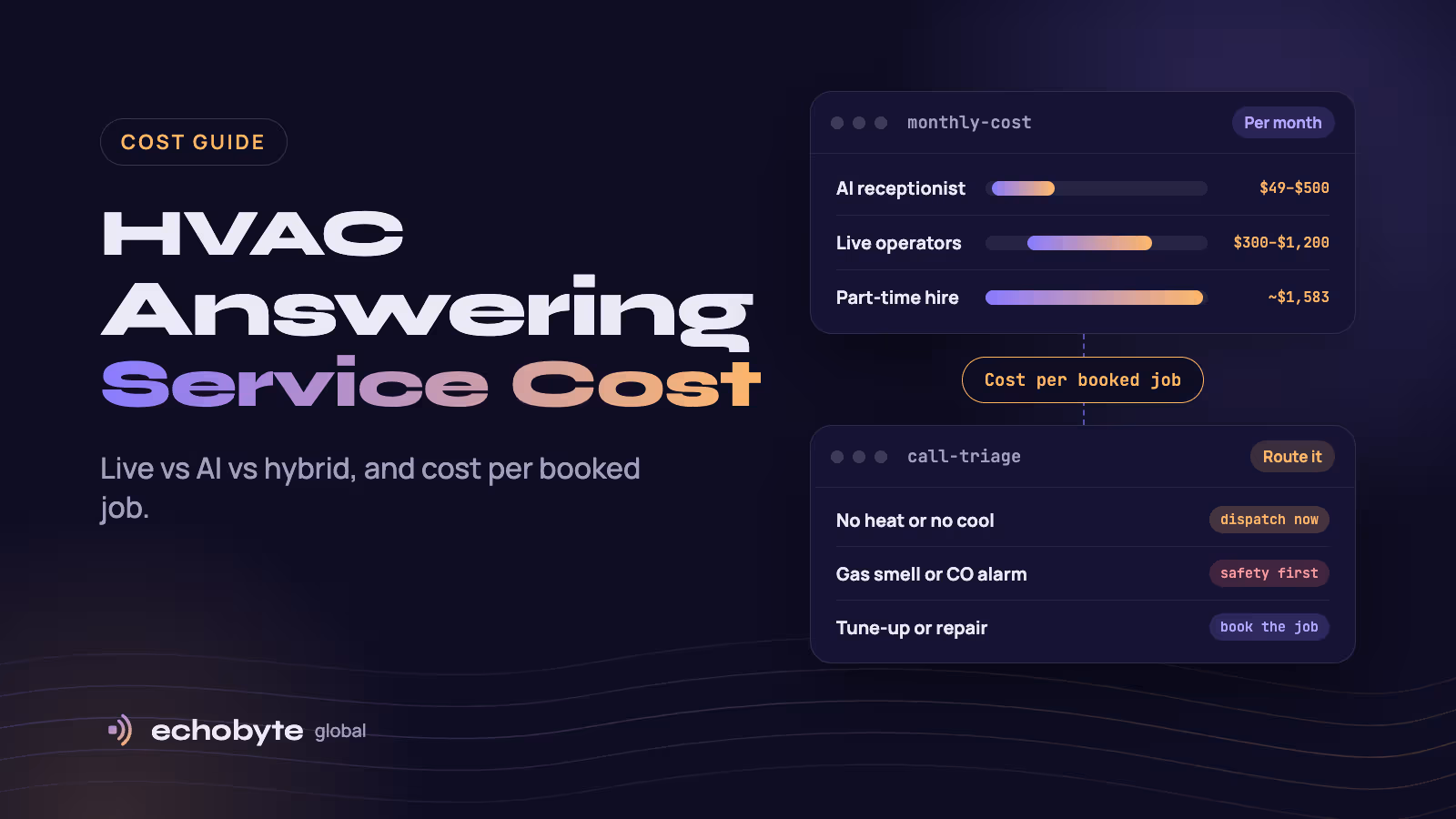
An HVAC answering service costs about $50 to $1,200 a month in 2026: roughly $50 to $500 for an AI receptionist, $300 to $1,200 for live operators, and more for hybrids that add a person to an AI. AI receptionists can book jobs straight into ServiceTitan, Housecall Pro or Jobber, while many live services mainly take messages and pass on emergencies. The right choice depends on your call volume, after-hours emergencies and dispatch software, and the number to compare is the cost per booked job, not the monthly price.
This guide compares live, AI and hybrid options for HVAC companies, with prices, what a missed call is worth, how to handle emergency calls, how to connect to your dispatch software, and what to ask before you sign. The same rules apply to plumbing and electrical companies. We build websites, SEO and ad campaigns for service businesses, so we focus on getting calls and tracking them, and we don’t sell an answering service. Prices come from vendor pages and 2026 comparison guides and change often, so confirm them before you buy.
Key takeaways
- Expect about $49 to $500 a month for AI, $300 to $1,200 for live operators, and about $293 and up for a live-plus-AI hybrid before overage charges.
- Live services mostly take messages and dispatch. AI can book into your schedule, but only if it connects to your software.
- Peak season can break per-call and per-minute plans, so check what happens when volume doubles.
- Emergency calls need clear rules: gas smells and carbon monoxide alarms are safety issues first and bookings second.
- Compare cost per booked job, and test any vendor with real calls before committing.
What does an HVAC answering service do?
It answers calls when you can’t, so a customer doesn’t hang up and call the next company. Services differ in how much they do:
| Type | Who answers | What it does | Typical cost |
|---|---|---|---|
| Live answering service | Remote human operators | Takes messages, follows your script, passes on emergencies | About $300 to $1,200 a month |
| AI receptionist | Software with a synthetic voice | Answers, triages, books jobs and texts emergencies to on-call | About $49 to $500 a month |
| Hybrid | AI first, humans for escalation | Combines both | From about $293 a month, plus overage |
| In-house receptionist | Your employee | Everything, during working hours | About $38,000 a year in wages |
| Voicemail | Nobody | Records a message | Free, and most callers hang up |
Our AI receptionist cost guide explains how these plans bill and what a full-time hire costs.
How much does an HVAC answering service cost?
Live services cost about $300 to $1,200 a month, AI receptionists about $49 to $500, and hybrids start near $293 before overage. These are 2026 starting prices from vendor pages and comparison guides, which disagree on some details:
| Option | Published starting price (2026) | Watch out for |
|---|---|---|
| Traditional live service (PATLive and similar) | About $235 a month for 75 minutes | Per-minute billing, with extra fees at peak times |
| Live service, HVAC-specific or full-service | About $600 to $1,200 a month | Trained operators and emergency routing cost more |
| Smith.ai AI receptionist | About $95 to $97.50 a month for 50 calls | Overage of about $2.40 to $4.25 per call |
| Smith.ai live plus AI | From $292.50 a month for 30 calls | About $9.75 to $11 per extra call, plus a setup fee |
| Rosie | About $49 a month for 250 minutes | The cheapest plan may not book appointments |
| Trades-focused AI (Marlie, Twig, Sameday) | About $49 to $449 a month | Check booking integrations and minute limits |
| Software add-ons (Jobber, Housecall Pro, ServiceTitan) | Add-on pricing, sometimes included on higher plans, some quote-only | Only works with that software |
Sources include NextPhone, Retell AI, Techloy and Vectrion. Several of these publishers sell AI receptionists, and prices differ between guides, so check each vendor’s pricing page.
The peak-season trap. Call volume in a heat wave or cold snap can run far above normal. A per-call or per-minute plan priced for March can cost several times more in July. Ask what the bill looks like when calls double.
What is a missed call worth to an HVAC company?
It depends on the job, and published numbers vary widely, so use your own. Industry figures for missed calls differ because they count different things:
| Measure | Published result |
|---|---|
| Home services missed-call rate (CallRail small-business benchmark, Jan 2025) | 14% |
| Home services calls answered by a person (Invoca benchmark, July 2026) | 52% of all inbound calls, 65% of calls over 15 seconds |
| Other vendor estimates for unanswered home-service calls | 20% to 30%, rising in peak season |
Those figures come from a 2026 summary of home services call data and vendor reports. Many calls are spam or wrong numbers, so not every missed call is a lost job. Job values range from about $350 for a service call to $8,000 or more for a full system replacement, according to one contractor marketing guide, and emergency visits cost more.
Use this formula with your own numbers:
Monthly revenue lost = missed calls × share that would have booked × average job value.
An illustration, not a forecast: you miss 20 calls a month, half would have booked and your average job is $450. That is 10 jobs, or $4,500 a month. A $300-a-month service that recovers even three of those jobs pays for itself several times over. If you don’t know your missed-call count, pull 30 days of data from your phone system.
Should you use live, AI or hybrid answering?
| Your situation | Likely best fit |
|---|---|
| Solo or small shop, mostly routine calls | AI receptionist with calendar booking |
| You run ServiceTitan, Housecall Pro or Jobber | The software’s own AI, or an AI that integrates natively |
| Many emergency calls where judgment matters | Live or hybrid, with clear escalation rules |
| Busy peak season and a small team | AI for overflow, with a flat or bundled plan |
| Mostly commercial accounts and complex quotes | Live operators or your own staff |
| Spanish-speaking callers | Check bilingual support before you buy |
Many shops run both: AI answers first and books routine jobs, and a person handles emergencies and complex calls. The point is not the technology but whether the caller ends up with a booked job or a callback.
How should an answering service handle HVAC calls?
With clear rules for each type of call, written down before you go live. An example setup:
| Call type | What should happen |
|---|---|
| No heat or no cooling, especially with vulnerable occupants | Mark as an emergency, quote the after-hours fee, alert the on-call technician |
| Gas smell or carbon monoxide alarm | Safety first: tell the caller to leave the building and call the gas utility’s emergency line or 911, then alert your on-call technician. Never treat it as a normal booking. |
| Routine repair or maintenance | Check the service area and book the next slot |
| Install or replacement quote | Capture details and schedule a human callback or estimate |
| Existing customer, billing or warranty | Route to the office or take a message |
| Spam and vendors | Filter out |
Also decide: your service area (by ZIP code), your hours and after-hours rules, the dispatch fees you quote, who gets paged and how, and what the caller hears if nobody picks up. Have an HVAC owner or a qualified person write the safety rules, and don’t leave them to a vendor’s default script.
How does it connect to ServiceTitan, Housecall Pro and Jobber?
Booking into your dispatch software is what separates a message-taker from a job-booker. Compare how each option connects:
| Software | Options |
|---|---|
| ServiceTitan | ServiceTitan’s own AI add-on, or third-party AI with an official integration |
| Housecall Pro | Housecall Pro’s CSR AI add-on, or third-party AI that books into the schedule |
| Jobber | Jobber’s AI Receptionist add-on (reported as included on its Plus plan), or third-party options |
| FieldEdge and Service Fusion | Offered by some trades-focused vendors; check which |
| No dispatch software | AI that books into a calendar, or message-taking with manual entry |
Quality varies. Ask whether the integration reads your live availability and zones, creates the job in your system and uses your price book. If your tools lack a direct integration, an automation tool can bridge the gap. Our Zapier vs Make vs n8n guide compares them, and our custom software service builds custom connections when off-the-shelf ones don’t fit.
What should you ask before you sign?
- Does it book jobs, or only take messages? Ask for a live demo into your system.
- How are emergencies handled? Who is called, in what order, and how fast?
- What is the full price? Include per-minute or per-call overage, holiday and after-hours fees, setup fees and minimums.
- What happens in peak season? Ask for a quote at double your normal call volume.
- Is there a contract? Look for month-to-month terms and a trial period.
- Which software does it connect to? Native, via Zapier, or not at all?
- Can it quote your dispatch fees and check your service area?
- Can callers choose Spanish or another language?
- Who owns the call recordings and customer data? Where are they stored and for how long?
- How does it disclose recording and AI? Rules vary by state. See the legal note below.
- Can I keep my number? Call forwarding or number porting should be easy.
- Can I hear real calls? Test with 20 awkward calls of your own before you commit.
How do you set it up in a week?
- List your top ten call reasons from the last month.
- Write the emergency rules and the safety script, with an HVAC professional.
- Add your prices. Dispatch fees, service area, hours and after-hours rates.
- Choose who gets paged and a backup, and set response times.
- Connect your dispatch software or calendar.
- Test with 20 calls, including angry, confused and after-hours ones.
- Review transcripts weekly for the first month and fix what the system gets wrong.
Does this work for plumbers and electricians?
Yes, with different emergency rules. For plumbers, the urgent calls are active flooding, sewer backups and burst pipes. For electricians, they are sparks, burning smells and loss of power with safety concerns. The same advice applies: write the triage rules, connect to your dispatch software, and compare cost per booked job. Search volume for “plumber answering service” and “AI receptionist for plumbers” is real, and the vendors are largely the same.
Where do your calls come from?
An answering service helps only if the phone rings. Most calls come from Google, your website, local listings and ads. If you pay for those clicks, an unanswered call wastes the spend. Our HVAC SEO guide explains how to bring in local calls, our Google Ads management pricing guide covers what ads should cost, and our SEO pricing guide covers local SEO. Make sure your website has a tap-to-call button that works on phones, and track calls in analytics so you know which source produces booked jobs. Our website audit checklist includes checks for mobile usability and conversion tracking.
What about call recording and privacy laws?
Rules on recording calls vary. About a dozen US states require all parties to consent, and some places require you to tell callers they are speaking with an AI. Play a short notice at the start of calls, ask vendors how they handle it, and check the rules where you operate. This is general information, not legal advice. Our AI receptionist cost guide covers the basics.
How can Echobyte help?
We don’t sell answering services. We build the pieces that make them work. Our web development service starts from $1,500 per project, and we have built a WordPress website for an AC installation and repair company. Our SEO service starts from $600 a month, with no ranking guarantee, and our paid ads service tracks Google and Meta campaigns through to revenue, with ad spend paid directly to the platforms. For a first look at AI and automation for a small business, see our guide to AI agents for small business. See our pricing page for starting prices.
HVAC answering service FAQ
How much does an HVAC answering service cost?
About $49 to $500 a month for AI receptionists, $300 to $1,200 for live operators, and from about $293 a month for hybrids, before overage. Peak season can raise per-call and per-minute bills.
Is an AI receptionist better than a live answering service for HVAC?
AI is cheaper and can book jobs into your schedule if it connects to your software. Live operators handle judgment calls better. Many shops combine them.
Can an AI receptionist book jobs in ServiceTitan or Housecall Pro?
Some can. ServiceTitan, Housecall Pro and Jobber each offer AI add-ons, and several third-party vendors integrate with them. Ask for a live demo into your own account.
How does an answering service handle emergencies?
It should follow your written rules: classify the call, quote your after-hours fee and alert your on-call technician. Gas smells and carbon monoxide alarms should trigger safety instructions first.
What does a missed call cost an HVAC company?
It depends on your job value and booking rate. Use missed calls × the share that would book × your average job value. Service calls run about $350 and replacements $8,000 or more.
Do I need an answering service if I have a receptionist?
Often yes, for after hours, lunch, peak season and when the receptionist is busy. A part-time hire costs about $1,583 a month at the median US receptionist wage, before benefits.
Is it legal to record calls with an AI receptionist?
Rules vary by state. About a dozen states require all parties to consent, so play a notice at the start of calls and check the rules where you operate. This is not legal advice.
Can the same service work for plumbers and electricians?
Yes. The emergency rules differ, such as flooding for plumbers and sparks for electricians, but the pricing, integration and testing advice is the same.
Want more of the right calls coming in? We build the website, local SEO and ad tracking that bring in booked jobs, and every project starts with a free discovery call and a fixed quote.
Sources
- Best AI Receptionist for HVAC 2026: 7 Compared, NextPhone
- Best Answering Service for HVAC Companies: 8 Tools Tested (2026), Retell AI
- 8 Best AI Receptionists for Home Services in 2026, Techloy
- HVAC Answering Service Cost in 2026, Vectrion
- Home Services Missed Call Revenue Statistics 2026, Stealth Agents (summarizing CallRail and Invoca)
- Answering Service for Plumbers, HVAC & Contractors, Alliance Virtual Offices
- AI for HVAC Businesses: A Practical Guide (2026), OpenCX
- Receptionists: Occupational Outlook Handbook, US Bureau of Labor Statistics