On this page
An AI receptionist costs about $25 to $400 a month for most small businesses, and most plans fall between $29 and $150. A live answering service costs roughly $200 to $1,750 or more a month for the same calls, and a full-time receptionist costs about $3,200 a month in wages before benefits. The price on the pricing page is rarely the price you pay, because plans bill by flat fee, minute bundle, call or caller, and the same 100 calls can cost $40 on one plan and $780 on another.
This guide compares AI receptionists, live answering services and hiring, with a worked cost example for 100 calls a month. It also covers the pricing models, hidden fees, when an AI receptionist is worth it, the legal checks to make, and when a custom build makes sense. We build AI agents as part of our custom software work, so we also say when buying beats building. Prices were checked in October 2026 and change often, so confirm them on each vendor’s page.
Key takeaways
- Most AI receptionist plans cost $29 to $150 a month. Entry plans start near $25, and premium or hybrid plans reach $300 to $400 and beyond.
- Live answering services typically cost $350 to $720 a month for 100 to 200 minutes, because they bill by the minute at about $1.95 to $5.00.
- Billing model matters more than the headline price. Count your calls and your average call length before you compare plans.
- An AI receptionist works best for routine calls, after-hours coverage and overflow, with a person for emergencies and complex cases.
- Tell callers when you record or use AI, and check your state’s recording rules.
What is an AI receptionist?
An AI receptionist is software that answers your business calls with a synthetic voice. It greets callers, answers common questions, takes messages, books appointments, sends a text link and transfers or escalates when it cannot help. It is different from voicemail, which only records a message, and from a live answering service, where a person answers.
Three things are often confused:
| Option | Who answers | Typical use |
|---|---|---|
| AI receptionist | Software with a synthetic voice | Routine calls, after-hours and overflow |
| Live answering service | Remote human agents | Calls that need a person, at a per-minute price |
| In-house receptionist | Your own employee | Front-desk work and the calls that need judgment |
Some vendors, such as Smith.ai, sell a hybrid: AI answers first and a human takes over when needed.
How much does an AI receptionist cost?
Entry plans cost about $25 to $65 a month, mid-tier plans $59 to $150, and premium or hybrid plans $200 to $400 or more. These figures come from vendor pricing and 2026 comparison guides, including AIRA and JustCall.
| Tier | Typical price | Examples (2026) |
|---|---|---|
| Entry | $25 to $65 a month | Upfirst from about $25, Dialzara about $29 for 60 minutes, Beside about $30 flat, Rosie about $49 for 250 minutes |
| Mid-tier | $59 to $150 a month | Goodcall about $59 to $79, Rosie about $149 for 1,000 minutes, Smith.ai’s AI plans from about $95 |
| Premium and hybrid | $200 to $400+ a month | Slang.ai about $399, and Smith.ai’s human-hybrid plans from about $292 |
Guides disagree on some entry prices and included calls, especially for Smith.ai, so treat any single figure as a starting point.
How do AI receptionist plans bill?
Five billing models cover most plans, and each hides a different trap.
| Model | How it works | Watch out for |
|---|---|---|
| Flat fee | A fixed monthly price, sometimes with a fair-use cap | Caps on unique callers or features, and less natural voices at the cheapest tier |
| Minute bundle | A monthly bundle of minutes, with overage past it | Long calls use up the bundle fast |
| Per call | A fee for each call handled, often with a small included amount | Spam and short calls still count, and overage rates can be high |
| Per minute | You pay for every minute of talk time | A 5-minute scheduling call costs five times a 1-minute question |
| Per unique caller | A cap on distinct callers each month | Fine for steady local customers, awkward for high-volume lines |
A 2026 guide from Voksha puts the average business call at three to four minutes and notes that at 100 calls a month, flat plans cost around $49 while per-minute plans can cost $325 to $1,100. Treat that as one vendor’s view, but the pattern is real.
What does 100 calls a month really cost?
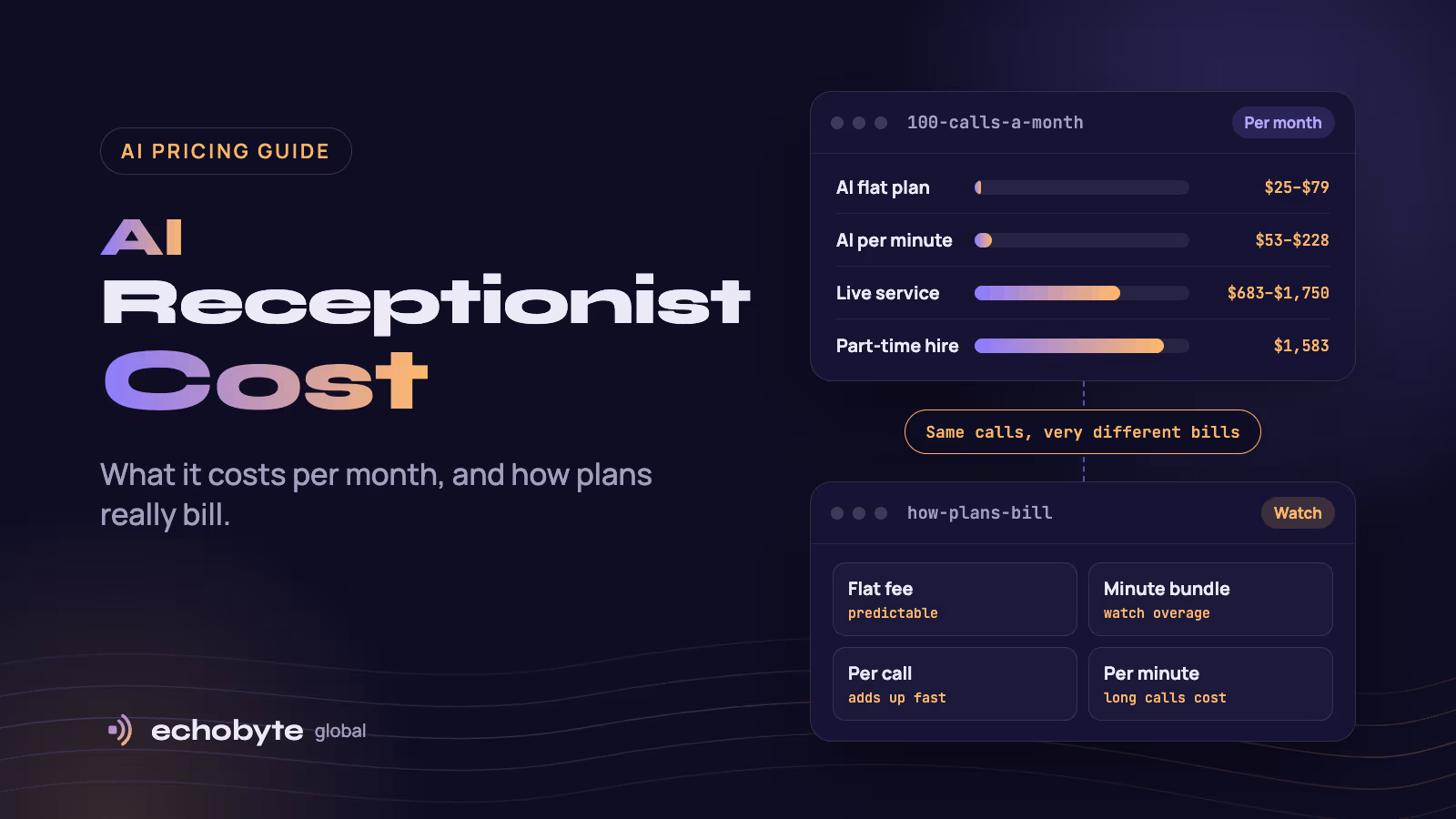
The same volume costs from about $25 to over $1,700 a month, depending on what you buy. Take 100 calls a month at 3.5 minutes each, which is 350 minutes.
| Option | How we estimate it | Monthly cost | Per call |
|---|---|---|---|
| AI receptionist, flat plan | $25 to $79 plans | $25 to $79 | $0.25 to $0.79 |
| AI receptionist, minute bundle | About $49, or $149 for a bigger bundle | $49 to $149 | $0.49 to $1.49 |
| AI receptionist, per minute | $0.15 to $0.65 a minute × 350 minutes | $53 to $228 | $0.53 to $2.28 |
| Live answering service | $1.95 to $5.00 effective per minute × 350 minutes | $683 to $1,750 | $6.83 to $17.50 |
| Part-time receptionist, 20 hours a week | $18.27 an hour × 1,040 hours, before benefits | About $1,583 | About $15.83 |
| Full-time receptionist, 40 hours a week | $38,010 a year, before benefits | About $3,168 | n/a |
The wage figure is the US Bureau of Labor Statistics’ May 2025 median for receptionists: $18.27 an hour, or $38,010 a year. Benefits usually add roughly 29% on top, according to BLS employer-cost data reported by ResumeGeni, which would put a full-time hire near $4,090 a month. The live answering range comes from dividing published plan prices by their included minutes, according to a Lethub analysis of Ruby and PATLive plans from August 2026. The AI per-minute range is our estimate from guides that put AI usage at about $0.05 to $0.65 a minute.
How does an AI receptionist compare with a live answering service or a hire?
| Option | Typical cost | Coverage | Best for | Limits |
|---|---|---|---|---|
| AI receptionist | $25 to $400 a month | 24/7 | Routine calls, after hours and overflow | Struggles with complex, emotional or noisy calls |
| Live answering service | $350 to $720 a month for 100 to 200 minutes, then per-minute overage | 24/7 with human agents | Calls that need a person | Per-minute billing gets expensive with volume |
| Hybrid (AI plus human) | From about $292 a month | 24/7 | Mixed call types and escalations | Per-call overage can be high |
| In-house receptionist | About $38,010 a year in wages, plus benefits | Working hours | Front-desk work and judgment calls | Cost, and no coverage after hours |
Calilio puts human-staffed services at $350 to $720 a month for 100 to 200 minutes, with overage typically $1.75 to $2.99 a minute.
What drives AI receptionist cost?
- Call volume and length. More minutes or calls cost more on any usage-based plan.
- Features. Calendar booking, CRM integration, text follow-up, call transfer and multilingual support often sit in higher tiers.
- Voice quality. Cheaper plans can sound more robotic.
- Number of locations or lines. Many plans price per location.
- Recording, transcripts and retention. Storage and access to recordings may cost extra.
- Custom behavior. Special scripts, intake forms and integrations can raise the price or require a custom build.
What hidden costs should you watch for?
- Overage. Per-call and per-minute overage can multiply a base plan. One guide shows a $292 base plan growing past $1,400 at 150 calls.
- Minimums and bundles. A “from” price usually covers few calls or minutes.
- Add-ons. CRM, calendar and recording features can cost more.
- Phone costs. You may still pay for your phone line or a call-forwarding service.
- Setup time. Testing scripts and escalation rules takes hours, and the cost is yours.
- Missed edge cases. A badly handled emergency call costs far more than the subscription.
Is an AI receptionist worth it?
It pays for itself when it recovers calls you would otherwise miss. Use this formula:
Monthly value = missed calls × share that would book × value of a booking.
An illustration. You miss 20 calls a month, 25% would book and a job is worth $300. That is 5 jobs, or $1,500 a month. If an AI receptionist at $79 a month recovers just one of those jobs, it covers its cost almost four times over. If it recovers none, cancel it.
It works best for businesses where calls come in while you are busy: HVAC, plumbing, dental, legal and salon. If you pay for traffic that rings your phone, unanswered calls waste that spend. See what Google Ads management costs, and how our HVAC SEO guide brings in calls. Our analytics service can count calls and form leads so you know what is working.
When is an AI receptionist a poor fit?
- Emergencies and urgent triage. A caller with a burst pipe or a medical issue needs a fast human path.
- High-value, consultative sales calls. Complex conversations need a person.
- Regulated data. Healthcare practices should check that a vendor will sign the agreements they need before routing patient calls.
- Callers who need empathy. Upset or vulnerable callers are better served by a person.
- Very low call volume. If you get a few calls a week, voicemail plus a callback may be enough.
What legal and privacy checks do you need?
Check these before you switch on call recording. This is general information, not legal advice.
- Recording consent. About a dozen US states require all parties to agree to a recording, and guides disagree on the exact list. If a caller could be in one of those states, play a short notice at the start of every call.
- Telling callers it is AI. Some places require you to disclose that they are speaking with an AI. Telling callers up front is good practice anyway.
- Data handling. Ask where recordings and transcripts are stored, how long, and whether they are used to train models.
How do you choose and set up an AI receptionist in a week?
- Count your calls. Check your phone log for monthly volume and average call length.
- List the top ten reasons people call. Hours, prices, booking, directions and emergencies are common.
- Pick a plan that fits your volume. Price your actual minutes or calls on each model, as in the table above.
- Write escalation rules. Decide which calls go straight to you or your staff.
- Test with 20 calls. Call it yourself with awkward questions.
- Connect your calendar or CRM. If the vendor lacks the integration, a simple automation can bridge it. Our Zapier vs Make vs n8n guide compares the tools.
- Review weekly. Read transcripts for the first month and adjust.
When should you build a custom AI receptionist?
Most small businesses should buy. A custom build makes sense when you need the receptionist to work inside your own booking system, follow unusual rules, or meet compliance requirements a vendor cannot. It costs far more. SolGuruz puts voice at $10,000 to $25,000 above a comparable text agent, and RaftLabs prices full voice agents at $50,000 to $150,000. Our AI agent development cost guide explains what drives that, and our guide to AI agents for small business shows where phone answering sits among other uses.
Our custom software service builds AI assistants and automation over your data, starting from $8,000 per project. We will tell you honestly if a ready-made tool does the job. See our pricing page for starting prices.
AI receptionist cost FAQ
How much does an AI receptionist cost per month?
Most small businesses pay $29 to $150 a month. Entry plans start near $25, and premium or hybrid plans cost $200 to $400 or more.
Is an AI receptionist cheaper than hiring a receptionist?
Usually, by a wide margin. A full-time receptionist earns a median of about $38,010 a year in wages before benefits, which is about $3,168 a month, while most AI plans cost under $150 a month. A person still handles calls that need judgment.
Is an AI receptionist cheaper than a live answering service?
Yes, for similar volume. Live services typically cost $350 to $720 a month for 100 to 200 minutes, and AI plans cost a fraction of that. Live agents suit calls that need a person.
Are there hidden fees?
Often. Common ones are per-call or per-minute overage, minimums, charges for integrations or recording, and your own phone line. Price your actual call volume before you commit.
How many calls can an AI receptionist handle?
Flat and unlimited plans handle any volume within fair-use limits. Bundles and per-call plans cap what is included and charge for the rest. Count your monthly calls and average length to compare them.
Can an AI receptionist book appointments?
Many can, if they connect to your calendar or booking system. Check that the integration works with the software you already use, because a plan that only takes messages is little better than voicemail.
Is it legal to record calls with an AI receptionist?
Rules vary by state. About a dozen US states require all parties to consent, so play a short recording notice at the start of every call, and check the rules where you operate. This is not legal advice.
Is an AI receptionist worth it for a small business?
It is worth it when you miss calls that would have become customers and the plan costs less than the jobs it recovers. It is a poor fit for emergencies and complex sales calls.
Want a receptionist built around your own booking system? Our team maps your workflows and builds AI assistants over your data, and every project starts with a free discovery call and a fixed quote.
Sources
- Receptionists: Occupational Outlook Handbook, US Bureau of Labor Statistics, May 2025 wages
- Best AI Receptionist Services for Small Businesses [2026], AIRA
- Best Smith.ai alternatives and Best Rosie AI alternatives, JustCall, 2026
- AI Receptionist Pricing Guide 2026, Voksha
- AI Voice Agent vs Human Answering Cost, Lethub, August 2026
- How Much Does Phone Answering Service Cost?, Calilio
- AI Receptionist Pricing in 2026: Complete Cost Comparison Guide, Tencent RTC, April 2026
- Receptionist Salary Guide 2026, ResumeGeni, citing BLS employer-cost data
- AI Agent Development Cost in 2026, SolGuruz, and RaftLabs