On this page
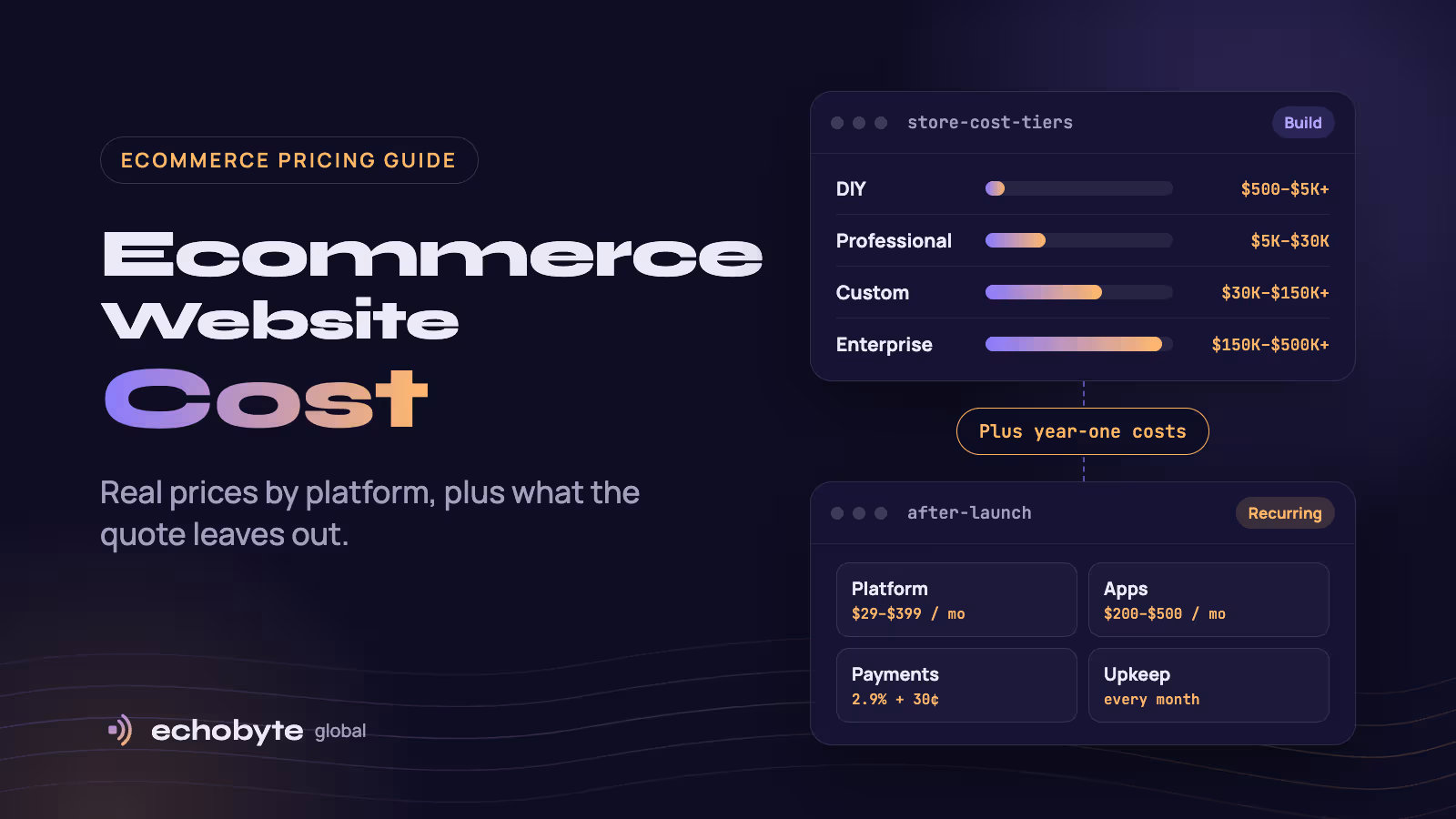
A professionally built ecommerce website costs about $5,000 to $30,000 on Shopify or WooCommerce, $30,000 to $150,000 for a custom or headless build, and $150,000 or more for large B2B and enterprise stores. A do-it-yourself store can launch for a few hundred to a few thousand dollars, plus monthly platform fees. Published guides disagree because they price different platforms, catalog sizes and amounts of custom work.
We compared five 2026 cost guides and explain why their numbers differ. Then we break down costs by platform, Shopify’s plans and fees, what drives the price, the costs a build quote leaves out, and how to compare quotes. We build stores on Next.js and Shopify, so we also show how we scope them. Prices were checked in October 2026.
Key takeaways
- Platform choice sets the cost model. Shopify and WooCommerce suit most small stores, and custom or headless builds cost several times more.
- The build is only part of year one. Platform fees, apps, payment processing and upkeep recur every month.
- Shopify plans run $29 to $399 a month on annual billing, and card payments cost about 2.5% to 2.9% plus 30 cents.
- Product photography, copy and data cleanup can cost as much as the build on a large catalog.
- Compare quotes on scope: platform, templates, product count, integrations, SEO and who owns the accounts.
How much does an ecommerce website cost?
Cost follows how much of the store is standard and how much is custom. These ranges combine two 2026 guides, from OuterBox and DBB Software. They are planning ranges, not quotes.
| Type of project | Typical build cost | Best fit |
|---|---|---|
| DIY or starter hosted store | $500 to $5,000+, plus monthly fees | Small catalogs, early tests and founder-led setup |
| Professional store on Shopify or WooCommerce | $5,000 to $30,000 | Retailers that want design help, setup, product loading and launch testing |
| Custom growth store or headless build | $30,000 to $150,000+ | Established stores with custom templates, integrations and conversion work |
| B2B, large catalog or ERP-connected store | $75,000 to $250,000+ | Customer-specific pricing, quotes, inventory and back-office integrations |
| Enterprise, multi-store or custom commerce platform | $250,000 to $500,000+ | High traffic, custom workflows and deep integrations |
The low end usually means standard platform features, fewer products and less customization. The high end adds strategy, custom design, product-data cleanup, technical SEO, integrations and support after launch.
Why do ecommerce cost guides disagree?
They price different stores. Here is what five guides say.
| Guide | Stated range | What stands out |
|---|---|---|
| OuterBox (May 2026) | $500 to $5,000+ for DIY, $25,000 to $150,000+ for custom, up to $500,000+ | Agency view, with the higher end covering B2B and headless |
| DBB Software (2026) | $5,000 to $20,000 basic, $30,000 to $70,000 custom, $100,000+ enterprise | Gives timelines for each tier |
| Project Cost Estimator (April 2026) | $2,000 to $80,000+, with a table by platform | Built on 600+ quotes. The page carries affiliate links |
| Webridge | About $15,000 for a custom Shopify theme, up to $250,000+ for custom headless | Calls a Next.js front end on Shopify the sweet spot |
| CartCoders | $60,000 to $200,000 for a headless Shopify build | Puts headless well above Webridge’s $30,000 to $70,000 starting point |
Five things explain the gap:
- Platform. A hosted Shopify store and a custom commerce platform are different products.
- Catalog size. A 20-product store and a 50,000-SKU catalog with variants differ enormously.
- Custom work. A theme setup costs far less than a custom design system and integrations.
- Who is writing. Many guides come from agencies or tools that sell what they price.
- Where the team is. Hourly rates vary widely by region.
Before you compare quotes, compare what each one includes.
How much does each ecommerce platform cost?
Platform choice drives a large share of the cost. Project Cost Estimator puts it at 50% to 70% of the total. Its 2026 ranges are below.
| Platform | Freelancer build | Agency build | Monthly cost | Best for |
|---|---|---|---|---|
| Shopify | $3,000 to $15,000 | $8,000 to $30,000 | $39 to $399 | Fast launches and D2C brands |
| WooCommerce | $2,000 to $12,000 | $5,000 to $25,000 | $30 to $200 | Content-heavy stores on WordPress |
| BigCommerce | $3,000 to $12,000 | $8,000 to $25,000 | $39 to $399 | B2B and no transaction fees |
| Wix or Squarespace | $500 to $3,000 | $2,000 to $6,000 | $27 to $65 | Small stores under about 100 products |
| Magento (Adobe Commerce) | $15,000 to $50,000 | $30,000 to $80,000+ | $350 to $1,000 | Large catalogs and enterprise |
Headless and fully custom builds sit above this table. Webridge puts a headless commerce MVP with a custom Next.js storefront at $30,000 to $70,000, and enterprise setups at $160,000 to $350,000. Treat these as planning figures, because guides disagree widely.
What do Shopify plans cost?
Shopify’s self-serve plans run $29 to $299 a month billed annually, or $39 to $399 billed monthly. These are the July 2026 prices reported by several pricing guides. Check Shopify’s pricing page before you decide, because plans and promotions change.
| Plan | Monthly billing | Annual billing | Card rate (Shopify Payments) | Fee if you use another gateway |
|---|---|---|---|---|
| Starter | $5 | $5 | 5% + 30¢ | n/a |
| Basic | $39 | $29 | 2.9% + 30¢ | 2% |
| Grow | $105 | $79 | 2.7% + 30¢ | 1% |
| Advanced | $399 | $299 | 2.5% + 30¢ | 0.6% |
| Plus | From $2,300 | n/a | Negotiated | 0.2% |
Shopify lists Plus at $2,500 a month on a one-year term and $2,300 on a three-year term, according to OuterBox. Using Shopify Payments avoids the extra gateway fee, but the card rate still applies. That monthly fee is not your whole Shopify cost. Theme work, apps, product setup, SEO and upkeep come on top.
What does WooCommerce really cost?
WooCommerce’s core software is free, but a store is not. According to OuterBox, WooCommerce lists hosting for most stores at about $25 to $350 a month, and extensions at $29 to $299 a year each. A real store also needs a theme, security, backups, payment tools, performance work and maintenance. Our website maintenance cost guide explains what keeping a WordPress site running involves.
What drives ecommerce website cost?
Catalog size, custom design, integrations and product data move the price most.
| Driver | Why it changes the price |
|---|---|
| Platform | Each has different setup, licensing, hosting, app and support costs |
| Catalog size | Variants, filters, attributes and product relationships all add work |
| Design and UX | A theme setup costs less than custom templates for category, product, cart and checkout pages |
| Payments, tax and shipping | Gateways, fraud rules, sales tax, carrier rates and subscriptions change the scope |
| Product data and migration | Names, images, categories, prices and redirects often need cleanup before launch |
| Integrations | CRM, ERP, inventory, email and product feeds need mapping, testing and error handling |
| SEO and analytics | Clean URLs, product schema, redirects and event tracking are cheaper to build in than to repair |
| Security and QA | Browser, mobile and checkout testing protect revenue |
| Who builds it | DIY, freelancer and agency prices differ, and so does who is accountable |
If you are moving an existing store to a new platform, read our website redesign cost guide first, because a careless migration can erase your search rankings.
What costs are not in the build quote?
A store has an ownership budget as well as a build budget. Project Cost Estimator lists these costs that quotes often omit:
- Payment processing. About 2.4% to 2.9% plus 30 cents a transaction on most platforms.
- Apps. A mid-range Shopify store with 8 to 10 apps can pay $200 to $500 a month on top of the plan.
- Photography. $25 to $100 per product.
- Product copy. $10 to $50 per product.
- SEO setup. $1,000 to $3,000 for category structure, metadata and schema.
- Email marketing. $50 to $300 a month for abandoned-cart and post-purchase flows.
On a 200-product catalog, photography alone can run $5,000 to $20,000 and copy $2,000 to $10,000. Add marketing on top. See what SEO costs and what Google Ads management costs before you set a launch budget.
Here is an illustration of a small Shopify store’s first year. Assume an agency build of $8,000 to $15,000, the Grow plan at $79 a month billed annually ($948 a year), $200 to $500 a month in apps ($2,400 to $6,000), and $10,000 a month in sales from 200 orders. Payment processing at 2.7% plus 30 cents then costs about $330 a month, or $3,960 a year. That is roughly $15,000 to $26,000 in year one, before marketing, photography and copy.
Should you choose Shopify, WooCommerce or a custom build?
Start with the simplest platform that covers your checkout and catalog needs.
| Your situation | Likely fit | Why |
|---|---|---|
| Small catalog, fast launch | Shopify | Hosting, checkout and payments are bundled |
| Content-heavy site with a shop attached | WooCommerce on WordPress | Keeps your blog and store in one editor |
| B2B pricing, quotes and company accounts | BigCommerce or custom | Built-in B2B tools, or a build around your workflow |
| Unique product logic, deep ERP links or a custom experience | Custom or headless | You pay for control and design freedom |
| A custom front end but standard back office | Next.js storefront on Shopify | Keeps Shopify’s checkout and adds your own design |
Many “custom” projects are really a platform plus custom apps. Our headless WordPress guide explains the trade-offs of splitting a site’s front end and back end. It also warns that a WooCommerce store needs a dedicated budget to go headless, because the cart, checkout and accounts must be rebuilt in the front end.
How long does it take to build an ecommerce website?
Basic stores take weeks, and custom stores take months. DBB Software puts a Shopify or WooCommerce build at 3 to 6 weeks, a custom mid-market store at 2 to 4 months, and enterprise builds at 4 to 7 months. Our website timeline guide puts a professionally built small store of under 50 products at 8 to 12 weeks, because it counts payments, shipping, tax, product data and testing. Late product data and slow approvals cause most delays.
What does ecommerce development cost around the world?
Rates vary more than anything else in the quote.
| Provider | Typical hourly rate |
|---|---|
| Mid-level Shopify developer | $45 to $90 |
| Senior Shopify developer | $90 to $160+ |
| Mid-tier agency | $75 to $140 |
| Premium agency | $120 to $200 |
These are CartCoders figures. Project Cost Estimator says Eastern European rates run 40% to 55% lower than Western Europe and the US. In India, Riolabz puts custom Laravel or Node.js stores at ₹4 to ₹18 lakh and headless builds at ₹8 to ₹30 lakh, or about $4,200 to $18,800 and $8,300 to $31,000 at roughly ₹96 per dollar. Those are agency-published figures, and the conversion is ours.
What does it cost to run a store after launch?
Budget monthly for the platform or hosting, apps, payment fees, maintenance, product updates, SEO, analytics and marketing. Stores change constantly, so keep a support plan. Our website maintenance cost guide covers what a plan includes. If your catalog is on Shopify, our guide to llms.txt for online stores shows what AI tools can already read from it. Set up proper tracking early, because you cannot improve what you do not measure. Our analytics service configures ecommerce events and dashboards. Most shoppers browse on phones, so our mobile-first design guide explains how to build for them.
How do you compare ecommerce quotes?
Ask every vendor to price the same scope:
- Which platform do you recommend, and why?
- Is this a theme setup, custom design or custom development?
- How many unique templates and products are included?
- Who cleans, imports and checks the product data?
- Are payments, tax, shipping and email notifications included?
- Are integrations included or only estimated?
- Are SEO, redirects, product schema and analytics included?
- Who owns the hosting, code, theme files, data and platform accounts?
- What support is included after launch?
Watch for red flags: vague scope, no product-data plan, no redirect plan, no staging site, no checkout test plan and unclear ownership.
How do we build ecommerce websites at Echobyte?
Our web development service builds fast, SEO-ready websites and storefronts on Next.js and Shopify. Website projects start from $1,500 and typically take 3 to 6 weeks. A store costs more because of products, payments, shipping and integrations, so we scope it on a discovery call and agree a fixed quote. Every project includes performance tuning, SEO foundations such as metadata, sitemaps and structured data, and analytics set up at launch. You own the code and accounts once the project is paid for.
If conversion is your problem, our UI/UX design team starts with your checkout flow. See our pricing page for starting prices.
Ecommerce website cost FAQ
How much does an ecommerce website cost?
A professional store on Shopify or WooCommerce usually costs $5,000 to $30,000. Custom or headless builds cost $30,000 to $150,000 or more, and enterprise stores cost $150,000 to $500,000 or more. A DIY store can cost a few hundred to a few thousand dollars.
How much does a Shopify website cost?
Shopify’s plans cost $29 to $299 a month on annual billing. A professionally built store typically costs $3,000 to $15,000 with a freelancer or $8,000 to $30,000 with an agency, plus apps, payment fees and upkeep.
Is Shopify cheaper than a custom website?
Usually yes at the start, because hosting, checkout and payments are included. A custom store costs more upfront because it is built around your workflow, data and design. The right choice depends on complexity and how much control you need.
Is WooCommerce really free?
The core software is free, but you still pay for hosting, extensions, security, backups, design and maintenance. OuterBox cites hosting at $25 to $350 a month for most stores.
How much does it cost to build a small online store?
A small store with under 50 products typically costs $2,500 to $10,000 on Shopify with a freelancer, and $5,000 to $25,000 when professionally planned, designed and tested. Your own time is a cost if you build it yourself.
What are the ongoing costs of an ecommerce website?
Platform or hosting fees, apps, payment processing (about 2.4% to 2.9% plus 30 cents), maintenance, security, product updates, SEO, analytics and marketing.
How long does it take to build an ecommerce website?
Basic Shopify or WooCommerce stores can take 3 to 12 weeks, depending on scope. Custom stores take 2 to 4 months and enterprise builds 4 to 7 months.
How do I keep ecommerce website costs down?
Start on a standard platform, limit apps, launch with a focused catalog, clean your product data before the build, and agree a fixed price for each phase.
Planning a store? Our team scopes, designs and builds ecommerce websites, and every project starts with a free discovery call and a fixed quote.
Sources
- eCommerce Website Pricing: How Much Does an eCommerce Website Cost in 2026?, OuterBox, May 2026
- eCommerce Website Development Cost, DBB Software, 2026
- Ecommerce Costs by Platform: Real 2026 Data, Project Cost Estimator, April 2026
- E-Commerce Website Development Cost in 2026 and Headless Commerce Platform Development Cost, Webridge
- Shopify Developer Cost: Hourly Rate and Project Pricing, CartCoders
- Shopify Pricing (2026): Full Plan Breakdown, Sellfy
- Shopify Pricing (2026): Plans, Fees & Real Costs, Shero Commerce, July 2026
- Cost of Custom Ecommerce Website Development in 2026, Riolabz