On this page
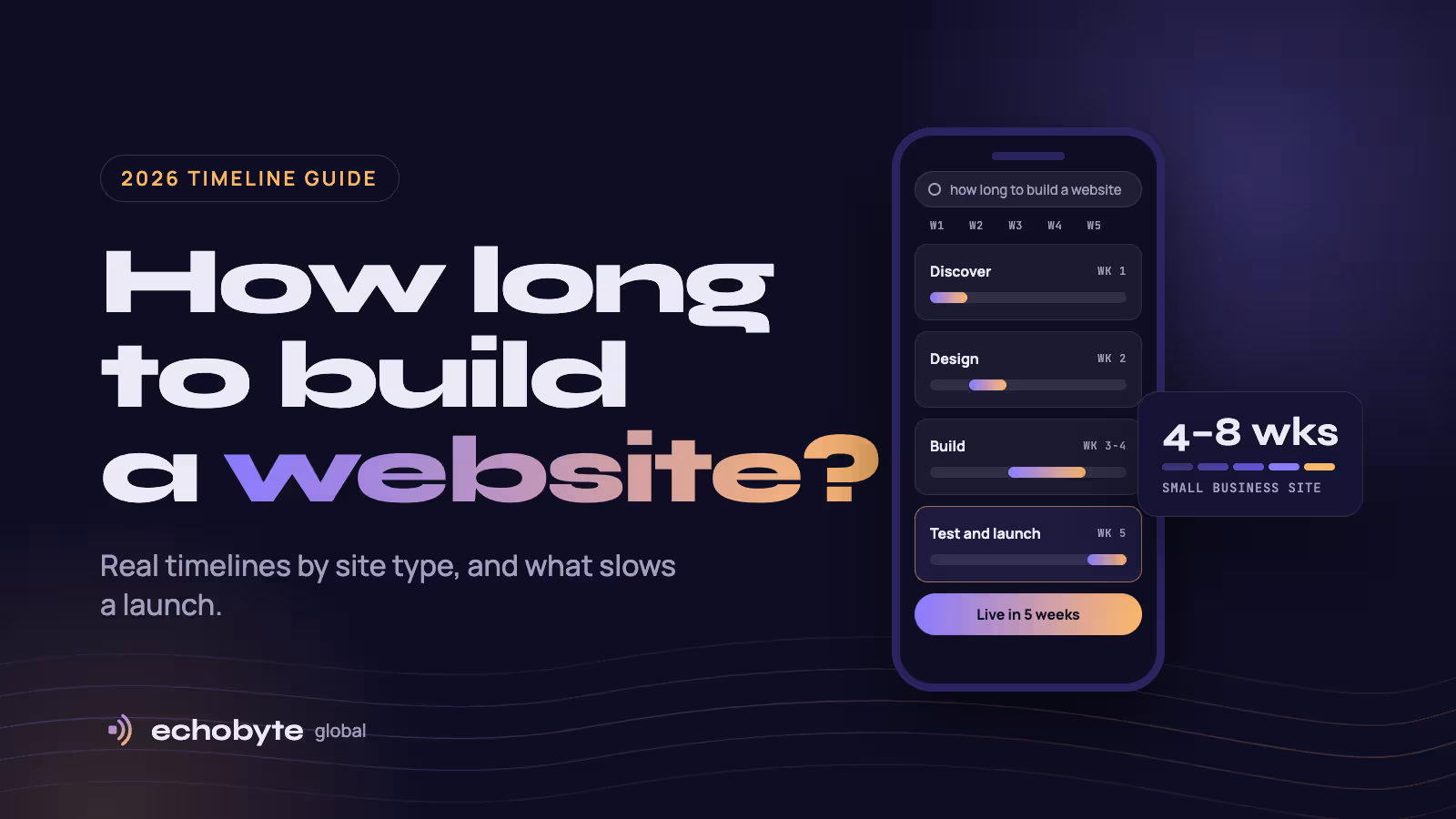
Most business websites take 4 to 8 weeks to build with a professional team. A simple brochure site can go live in 1 to 2 weeks, a small online store usually takes 8 to 12 weeks, and a custom platform can take six months or more. The biggest variable is rarely the developer’s speed. It is how ready your content and decisions are when the project starts.
Guides disagree because they time different things. Some stop when the site is built, others count discovery, content, feedback and launch, and some assume a DIY builder while others assume an agency. We compared three recent guides with our own project timelines. This article puts the numbers side by side, shows where the weeks go, and lists what you can do to launch sooner.
How long does it take to build a website?
It depends on the type of site, but most projects fall into these ranges. The timelines assume a professional team and include design, build, content and testing.
| Type of website | Typical timeline | Main driver |
|---|---|---|
| Simple brochure site (1 to 5 pages) | 1 to 2 weeks | Content and one round of design feedback |
| Small business site (5 to 15 pages, blog, forms) | 4 to 8 weeks | Custom design, content and revisions |
| Marketing site with a CMS on Next.js (ours) | 3 to 6 weeks | Page count and speed of feedback |
| Custom site with booking, payments or CRM | 8 to 14 weeks | Integrations and testing |
| Small online store (under 50 products) | 8 to 12 weeks | Payments, shipping, tax and product data |
| Web app MVP | 6 to 10 weeks | Features and backend |
| Mobile app MVP (iPhone and Android) | 10 to 16 weeks | Features and backend |
| Large store or custom platform | 4 to 12+ months | Scale, integrations and security |
A drag-and-drop builder can put a simple site online much faster if your content is ready. Elementor puts a DIY brochure site at 1 to 3 days. The ranges above are for sites built by a team.
Why do website timeline guides disagree?
They measure different things. Here is what three recent guides say for similar projects.
| Source | Small business site | Simpler option | Complex build |
|---|---|---|---|
| Elementor (updated June 2026) | 4 to 8 weeks | 1 to 2 weeks for a brochure site | 4 to 6+ months for large custom sites |
| Colorado Web Impressions (April 2026) | 4 to 8 weeks for 10 pages | 2 to 3 weeks from a template | 8 to 14 weeks with integrations |
| SolveIt (February 2026) | 1 to 3 months for a medium site | 1 to 2 months for a simple custom site | 3 to 6+ months |
Three things explain most of the gap:
- Scope of the count. SolveIt writes about custom-coded B2B sites and includes discovery and testing, so its numbers run longer. Others time only design and build.
- Template or custom. A template-based site can launch in weeks. Custom design, copywriting and photography add weeks.
- Who is waiting on whom. The same site takes twice as long when content and approvals arrive late.
Before you compare quotes, compare what each timeline includes.
Where does the time go in a website project?
A website build has six stages, and they overlap. Elementor’s breakdown gives these typical durations.
| Stage | Typical duration | What happens | What usually delays it |
|---|---|---|---|
| Discovery and scope | 1 to 2 weeks | Goals, page list, sitemap, wireframes | Unclear goals, too many stakeholders |
| Design | 1 to 4 weeks | Mockups and revision rounds | Slow or scattered feedback |
| Build | 1 to 8+ weeks | Pages, forms, CMS, integrations | Features added mid-build |
| Content | 1 to 3 weeks | Copy, photos, product data | Content not ready |
| Testing | 1 to 2 weeks | Phones, browsers, forms, speed | Rushed or skipped |
| Launch | 1 day to 1 week | Domain, DNS, analytics, sitemap | Missing access to accounts |
Add up the top of every range and you get months. Real projects run content alongside design and build, which is why a five-week project is possible.
What does a five-week marketing website look like?
Our published range for a marketing website is three to six weeks. Here is how a typical five-week build runs through our four steps: discover, design, build, launch.
| Week | What happens | What we need from you |
|---|---|---|
| 1 | Discovery call, written scope, fixed quote, page list | Goals, examples you like, domain access |
| 2 | Wireframes, then polished designs for key pages | Feedback within a couple of days, approval of every page before code |
| 3 to 4 | Build on a live staging link with a weekly demo, content added as it arrives | Final copy and images, one person who signs off |
| 5 | Testing on phones and browsers, speed and SEO checks, launch | Final approval, DNS access |
Fewer pages usually mean the short end of the range. Late content or extra design rounds push it toward the long end.
What slows a website project down?
Almost always, it is waiting, not building. These are the most common causes.
- Content isn’t ready. Elementor calls missing copy and images the number one reason projects stall. Writing, sourcing and approving content can take longer than design and build combined.
- Slow or scattered feedback. A Colorado agency says the biggest delays are usually client-side: late content, late feedback and mid-project changes. Every day spent waiting on an approval is a day added to the launch date.
- Scope creep. A 10-page site that grows to 18 pages needs a new timeline and a new price. Elementor notes that even a simple request like user logins can add weeks.
- Integrations. Booking, payments and CRM sync are what push custom sites from the 4 to 8 week range into 8 to 14 weeks.
- Two systems instead of one. A headless setup, such as a CMS with a Next.js front end, means building and connecting two parts. Our headless WordPress guide covers the trade-offs.
- Domain and DNS problems. SolveIt notes that DNS issues can stretch the usually fast hosting and domain setup step.
How does your platform change the timeline?
The platform decides how much has to be built from scratch.
| Platform | Effect on timeline | Watch for |
|---|---|---|
| Website builder (Wix, Squarespace) | Fastest for simple sites, days for a DIY brochure site | Limits on design and features |
| WordPress with a theme or page builder | Fast for content sites, 4 to 8 weeks for a professional small business build | Plugin updates after launch |
| Shopify or another store platform | Depends on product count, theme changes and app integrations | Product data and payment setup |
| Custom Next.js site | More design freedom, 3 to 6 weeks for our marketing sites | SEO basics, such as sitemaps and tags, are built in code |
| Headless WordPress | Two systems to build and connect | More developer time, previews need setup |
Whatever platform you choose, plan for what happens after launch. Our website maintenance cost guide covers that. If your project is an app, read our guides to MVP development and app development cost.
How can you launch your website faster?
Prepare before the project starts and keep decisions moving. These habits save the most time.
- Write the content first. Have approved copy and images for the core pages before kickoff.
- Name one decision-maker. One person who can approve designs beats a committee.
- Lock the page list. Park extra pages and features for a second phase.
- Agree on feedback windows. A two-business-day response keeps design from stalling.
- Choose the simplest platform that fits. If a template does the job, don’t build custom.
- Design for phones first. It avoids rework later. See our mobile-first design guide.
- Collect your accounts early. Domain registrar, hosting, analytics and your Google Business Profile logins save days at launch.
- Don’t compress testing. Colorado Web Impressions says a custom-designed site delivered in under about three weeks usually skipped discovery, copywriting or QA.
What happens after launch?
Launch starts the next phase of work. Submit your sitemap in Google Search Console and check that analytics are tracking. Then plan ongoing maintenance and SEO. New pages usually take weeks to months to rank, and our HVAC SEO guide puts it at three to six months for a new service business site. If you want AI tools to cite your pages, start with our AI search optimization guide.
How long does it take to build a website FAQ
How long does it take to build a website?
Most business websites take 4 to 8 weeks with a professional team. A simple brochure site takes 1 to 2 weeks, a small online store 8 to 12 weeks, and a custom platform six months or more. Content readiness and feedback speed change the timeline more than the technology.
How long does it take to build a small business website?
Four to 8 weeks for a typical site of 5 to 15 pages with a blog and forms. Template-based sites can launch in 2 to 3 weeks, and sites with booking, payments or CRM integrations take 8 to 14 weeks.
How long does it take to design a website?
Design usually takes 1 to 4 weeks. The revision rounds are the variable: a decisive client can approve designs in a week, while a large review committee can take a month.
How long does it take to build a WordPress website?
A professionally built small business WordPress site typically takes 4 to 8 weeks. Using a theme or prebuilt kit can shorten that, and custom design, plugins and integrations lengthen it.
How long does it take to build an ecommerce website?
A small store with under 50 products usually takes 8 to 12 weeks with a professional team. Large stores with hundreds of products and inventory integrations take 4 to 8 months.
How long does a website redesign take?
It takes about as long as a new build, because the design and content work is the same. One agency guide puts redesigns at 6 to 12 weeks.
Can a website be built in a week?
Yes, for a simple 1 to 5 page site with content ready. For a custom-designed business site, a week usually means skipping discovery, copywriting or testing.
Why is my website taking so long?
The usual causes are content that isn’t ready, slow feedback, and pages or features added mid-project. Asking for a written scope and a weekly demo makes delays visible early.
How long until a new website shows up on Google?
Indexing can take days to a few weeks. Ranking usually takes weeks to months, depending on competition and how many sites link to yours.
Planning a website? We design, build and launch websites and apps for businesses worldwide. Every project starts with a free discovery call and a written scope with a fixed quote. See our website development service and pricing.
Sources
- How Long Does it Take to Build a Website in 2026?, Elementor, updated June 29, 2026
- How long does it take to build a business website?, Colorado Web Impressions, updated April 30, 2026
- How long does it take to build a website?, SolveIt, February 19, 2026
- How Long Does It Take to Build a Website, Ambrite (redesign range)