On this page
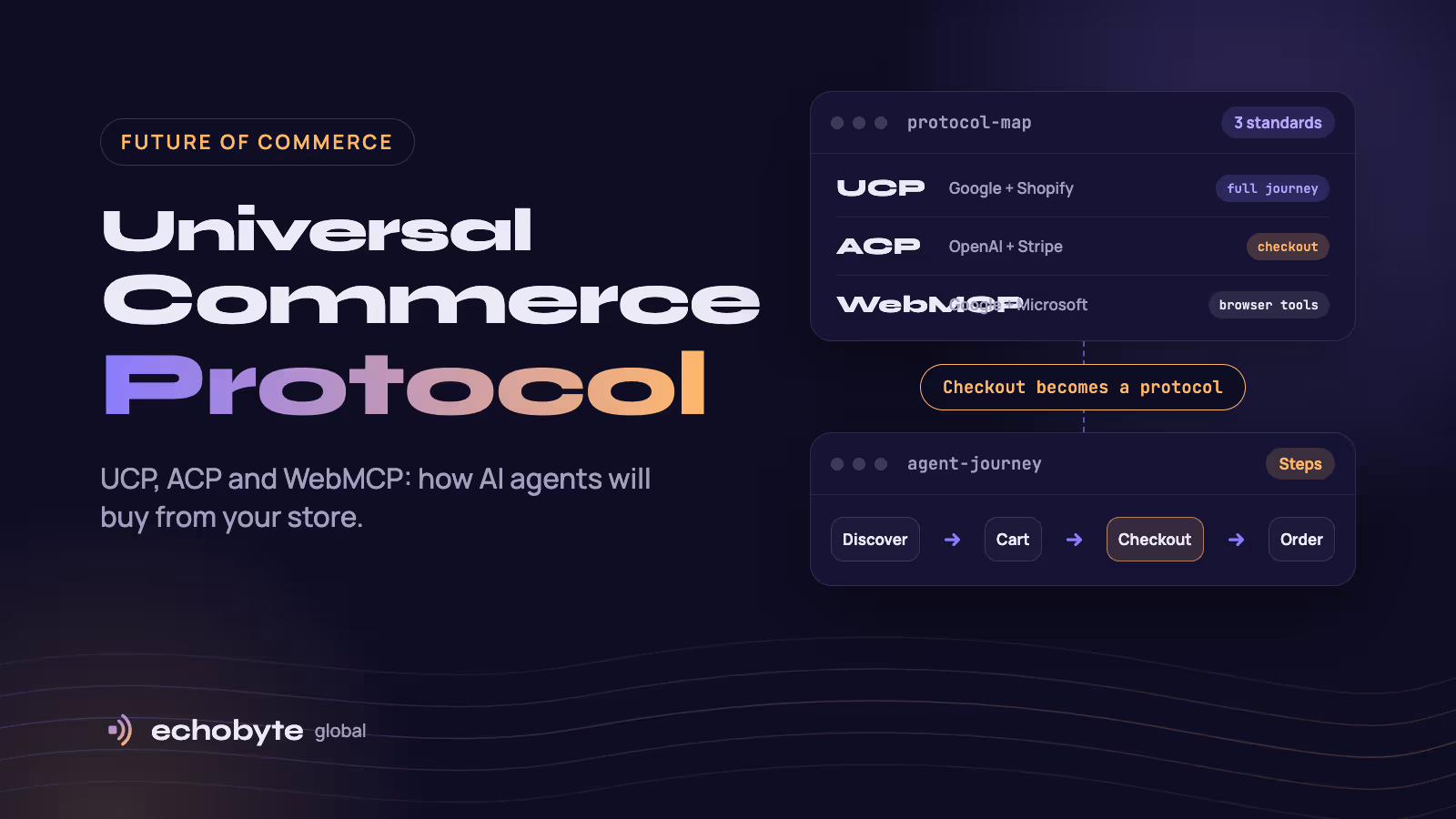
The Universal Commerce Protocol (UCP) is an open standard that lets AI agents find products, build a cart and check out on a shopper’s behalf, using a profile a store publishes at /.well-known/ucp. Google and Shopify announced it on January 11, 2026. It sits alongside the Agentic Commerce Protocol (ACP), built by OpenAI and Stripe for checkout in ChatGPT, and WebMCP, a browser standard that lets web pages expose tools to agents. Shopify merchants can get UCP and ACP through Agentic Storefronts, and other stores must implement the standards directly. Either way, clean product data, structured markup and tracking are worth fixing now.
This guide explains what agentic commerce is, how UCP, ACP, WebMCP and related protocols differ, how an agent buys from a store, which AI platforms support what, how big the shift really is, and what to do about it, with a readiness checklist. It is early, standards are still changing, and forecasts disagree, so we say where the evidence is thin. Information was checked in November 2026.
Key takeaways
- Agentic commerce means AI agents research, compare and buy for people. Checkout moves from your page into the agent’s interface.
- UCP covers the whole shopping journey, ACP focuses on checkout, and WebMCP lets pages expose actions to browser agents. They are not mutually exclusive.
- Shopify merchants can enable both UCP and ACP through Agentic Storefronts. Check your settings and your manifest.
- Consumer trust lags the technology. One survey found 65% trust AI to compare prices, but only 14% trust it to place an order.
- Start with product data quality, structured markup, crawler access and tracking. They help with AI search too.
What is agentic commerce?
It is online shopping where an AI agent does the work. The shopper states a goal, such as “find a waterproof jacket under $150”, and the agent searches, compares, builds a cart and, with the shopper’s approval, completes the purchase. In traditional ecommerce the seller builds the checkout. In agentic commerce the agent presents the checkout inside its own interface and the merchant receives an order through an API. Search Engine Journal’s guide puts it as checkout becoming a protocol, not a page.
What is the Universal Commerce Protocol (UCP)?
UCP is an open standard for how AI agents and merchants talk to each other across the full shopping journey. Google and Shopify announced it at the National Retail Federation conference on January 11, 2026. Etsy, Wayfair, Target and Walmart co-developed it, and more than 20 companies endorsed it at launch, including Mastercard, Visa and Stripe.
How it works:
- A published profile. The merchant publishes a JSON profile at
/.well-known/ucpthat lists what the store supports. Agents publish their own capabilities, and the two sides work out what they can do together on each request. - Capabilities. These include catalog and product discovery, cart, checkout and orders, with identity and loyalty linking and other areas being added.
- Layers. A core shopping service, independently versioned capabilities and extensions for specific industries, which makes it similar in spirit to how TCP/IP is layered.
- Transports. REST, MCP, Agent2Agent (A2A) and Google’s Agent Payments Protocol (AP2).
- Merchant stays in control. The retailer remains the merchant of record and keeps the customer relationship, pricing, fulfillment and data. Payments go through the merchant’s own gateway.
According to Impression’s July 2026 rollout summary, UCP checkout is live in Google AI Mode and the Gemini app for major US retailers and Shopify merchants, the UK rollout is phased through mid-2026, and the EU is following a path shaped by GDPR and the Digital Markets Act.
How do UCP, ACP, WebMCP and the other protocols differ?
| Protocol | Built by | What it does | Layer |
|---|---|---|---|
| UCP | Google and Shopify, with retailers | Full commerce journey: discovery, cart, checkout and orders | Commerce |
| ACP | OpenAI and Stripe | Checkout flow with four endpoints (create, update, complete, cancel). Powers Instant Checkout in ChatGPT | Checkout |
| AP2 | Google, with 60+ partners | Proof of user consent and payment authorization for agent-initiated payments | Payments |
| MCP | Open standard | Connects AI tools to data sources, APIs and apps | Tool access |
| A2A | Open standard | Lets agents talk to other agents | Agent communication |
| WebMCP | Google and Microsoft (W3C community group draft) | Lets a web page expose structured tools to a browser agent. Early preview in Chrome 146 | Browser |
In plain terms: WebMCP helps an agent use your web pages, UCP and ACP let it complete the purchase, and AP2 and card-network standards such as Visa’s Trusted Agent Protocol and Mastercard’s Agent Pay handle trust and payment. ACP was announced on September 29, 2025, and Stripe launched an Agentic Commerce Suite in December 2025 to help merchants sell through several agents with one integration. ACP integration effort is described as days for existing Stripe merchants, while UCP is weeks to months.
How does an AI agent buy from a store?
- The shopper asks. The agent interprets the request and decides what to search.
- The agent finds products. It reads product data from feeds, structured markup or a protocol such as UCP.
- It compares and builds a cart. It uses your real prices, stock and shipping rules.
- Checkout happens in the agent’s interface. The shopper approves, often through a native or embedded checkout.
- A payment token passes to the merchant. The agent never needs the shopper’s card details. Stripe’s Shared Payment Tokens, for example, are limited by merchant, amount and time.
- The merchant fulfills the order as the merchant of record, and can also support returns and order updates through the same channel.
Which AI platforms support what?
| Platform | How it connects | Status (2026 reports) |
|---|---|---|
| ChatGPT | Instant Checkout, built on ACP | Live for US users, with merchants such as Etsy and Walmart |
| Google AI Mode and Gemini | Native and embedded checkout through UCP | Live for major US retailers and Shopify merchants |
| Microsoft Copilot | Copilot Checkout | Live with select merchants |
| Perplexity | Instant Buy with PayPal, and shopping features | Live in the US |
| Shopify’s Agentic Storefronts | One admin setting that syndicates your catalog to several of the above | Rolled out from March 2026 to eligible merchants |
Check each platform’s current status before you plan around it. Rollouts differ by country, and details change quickly.
How big is agentic commerce, really?
Early, with wide forecasts. McKinsey projects $1 trillion of US retail revenue orchestrated by agents by 2030, and $3 trillion to $5 trillion globally. Morgan Stanley estimates agentic AI will account for 10% to 20% of US ecommerce by 2030. Gartner predicts agents will handle most B2B purchases by 2028. Those forecasts are far apart, which tells you how new this is.
What is measurable today: Adobe reported AI-driven traffic to US retail sites grew 4,700% year over year by mid-2025, and Shopify reported AI-attributed orders up 11 times since January 2025. Both start from a small base. On the consumer side, a YouGov survey of 1,287 US adults found 65% trust AI to compare prices but only 14% trust it to place an order, and a Contentsquare survey found 30% willing to let an agent complete a purchase. Shoppers are using AI to research well before they let it buy.
What should store owners do?
| Your setup | What to do |
|---|---|
| Shopify | Review Agentic Storefronts in your admin, choose channels and products, and validate your manifest |
| Stripe-based custom store | Look at Stripe’s Agentic Commerce Suite for ACP, and plan for UCP |
| WooCommerce, BigCommerce, Wix or Squarespace | Check for Stripe Suite or platform integrations |
| Custom or headless storefront | Implement UCP directly or through your commerce backend, and consider an MCP server for your catalog |
| Service business or SaaS (no cart) | Focus on machine-readable pricing, services, booking and structured data |
On Shopify, enabling Agentic Storefronts generates the /.well-known/ucp file for you. One developer write-up warns that the generated manifest can still have gaps, such as empty fields or missing signing keys, so test it. A quick check is whether curl -I https://yourstore.com/.well-known/ucp returns 200 with a JSON content type over HTTPS, followed by a review of the capabilities listed.
What is the agent-readiness checklist?
- Clear product titles. “Men’s organic cotton crew neck T-shirt, navy” beats “Blue shirt”.
- Complete descriptions. Materials, dimensions, care, compatibility and use cases.
- Accurate price and stock in real time, including variants.
- Product and Offer structured data with name, description, image, SKU, brand, price, currency and availability, plus ratings if you have reviews.
- A clean merchant feed such as Google Merchant Center, with consistent categories and identifiers.
- Written policies. Shipping, returns and warranty in plain text on their own pages.
- Fast, server-rendered pages. Agents often read text, not styled pages, so content must be in the HTML.
- Crawler access. Do not block AI crawlers such as OAI-SearchBot, PerplexityBot, Googlebot or Bingbot by accident, and keep your site indexed in Bing.
- A valid manifest and endpoints if you implement UCP or ACP yourself, with tested checkout.
- Bot rules that do not block good agents. Bot protection should distinguish verified agents from abuse.
- Tracking for AI traffic. Watch referrals such as
utm_source=chatgpt.com, set up server-side events for checkouts that never load your pages, and handle consent. Our Google Consent Mode v2 guide covers consent for Google tags. - A test. Ask ChatGPT, Gemini, Copilot and Perplexity for products in your category and note whether you appear.
Our website audit checklist covers several of these checks, and our guide to llms.txt for online stores explains what that file does and does not do. Our AI search optimization guide covers being cited in AI answers.
What are the risks and trade-offs?
- You give up the on-site experience. If checkout happens in the agent, you lose visual merchandising, upsells and page views. UCP’s embedded checkout and identity linking can restore some of that.
- Your product data becomes the storefront. Conversion work shifts from button colors to feed quality, attributes and stock accuracy.
- Attribution gets murky. Client-side pixels do not fire in agent checkouts, so server-side measurement and incrementality tests matter.
- Security. A 2025 study found all tested shopping agents were vulnerable to visual prompt injection, where malicious content in a listing hijacks the agent.
- Homogenization. A Columbia and Yale simulation found agents concentrate demand on a few products and show position bias, which can reward sellers who optimize for agents.
- Platform dependence. Standards and rollouts are controlled by a few large companies.
- Trust. Most shoppers are not ready to let agents buy for them yet.
What about service businesses and SaaS?
Not every business sells products from a cart, but the idea applies. Agents book appointments, request quotes and compare providers. The same groundwork helps: clear pricing and service pages, structured data, accurate hours and locations, forms and APIs that work, and content that answers questions directly. Our guide to AI agents for small business shows where automation fits, and our custom software service builds integrations when off-the-shelf tools do not.
What is next?
These are predictions, not facts. UCP is expected to expand beyond retail into areas such as hospitality and bookings, with identity and loyalty features. WebMCP is in early preview and could make pages easier for agents to use without scraping. UK and EU rollouts depend on regulation and consent rules. Payment networks will keep adding agent standards. The one safe bet is that machine-readable data helps in every scenario.
How can Echobyte help?
Our web development service builds Next.js sites and Shopify storefronts, and includes metadata, sitemaps, structured data and llms.txt from day one. Our SEO service starts with a technical audit and has no ranking guarantee, and our analytics service sets up tracking and consent. If you want agent-readiness checks, such as a manifest test and a product-data review, tell us on the first call so they are part of the scope. See our ecommerce website cost guide and our pricing page for starting prices.
Universal Commerce Protocol FAQ
What is the Universal Commerce Protocol?
An open standard, co-developed by Google and Shopify and announced in January 2026, that lets AI agents discover products, build carts and check out with merchants. Stores publish a profile at /.well-known/ucp that declares what they support.
What is the difference between UCP and ACP?
UCP covers the full shopping journey and powers checkout in Google AI Mode and Gemini. ACP, from OpenAI and Stripe, focuses on checkout and powers Instant Checkout in ChatGPT. Shopify merchants can support both.
What is WebMCP?
A browser standard, drafted by Google and Microsoft in a W3C community group, that lets a web page expose structured tools to AI agents. It was in early preview in Chrome 146.
Do I need UCP for my store?
Not necessarily today. Shopify merchants can enable it through Agentic Storefronts. Other stores can wait, but should fix product data and structured markup now.
How do I know if my Shopify store works with UCP?
Check Agentic Storefronts in your admin, then confirm that /.well-known/ucp returns valid JSON over HTTPS, and review the capabilities and fields it lists.
Will AI agents replace shoppers?
Not soon. Surveys show most people use AI to research and compare, and few trust it to place orders. Agent-driven purchases are growing from a small base.
How do I track sales from AI agents?
Watch referral sources such as utm_source=chatgpt.com, add server-side purchase events, and keep consent and tracking in order.
Is this only for big retailers?
No. Shopify and Stripe have made the setup available to small merchants, and the groundwork of accurate product data helps every store.
Want to know if AI agents can read and buy from your store? Our team reviews your product data, structured markup and tracking, and every project starts with a free discovery call and a fixed quote.
Sources
- Selling To AI: The Complete Guide To Agentic Commerce, Search Engine Journal, April 2026
- Navigating Agentic Commerce with Universal Commerce Protocol, Impression, August 2026
- Universal Commerce Protocol, UCP project site
- Agentic Commerce Protocol, ACP project site
- Agentic commerce guide, Stripe
- Universal Commerce Protocol (UCP) Explained: What Shopify Merchants Need to Know, Ecommerce Fastlane
- How to Prepare Your Shopify Store for Agentic Commerce and UCP, Shero Commerce
- Shopify Agentic Storefronts Enabled? Your UCP Profile Still Has Gaps, DEV Community
- Agent-Ready or Agent-Invisible: How WebMCP Rewrites the Rules of Digital Commerce, Infosys
- Top agentic AI protocols for website growth in 2026, Wix Studio