On this page
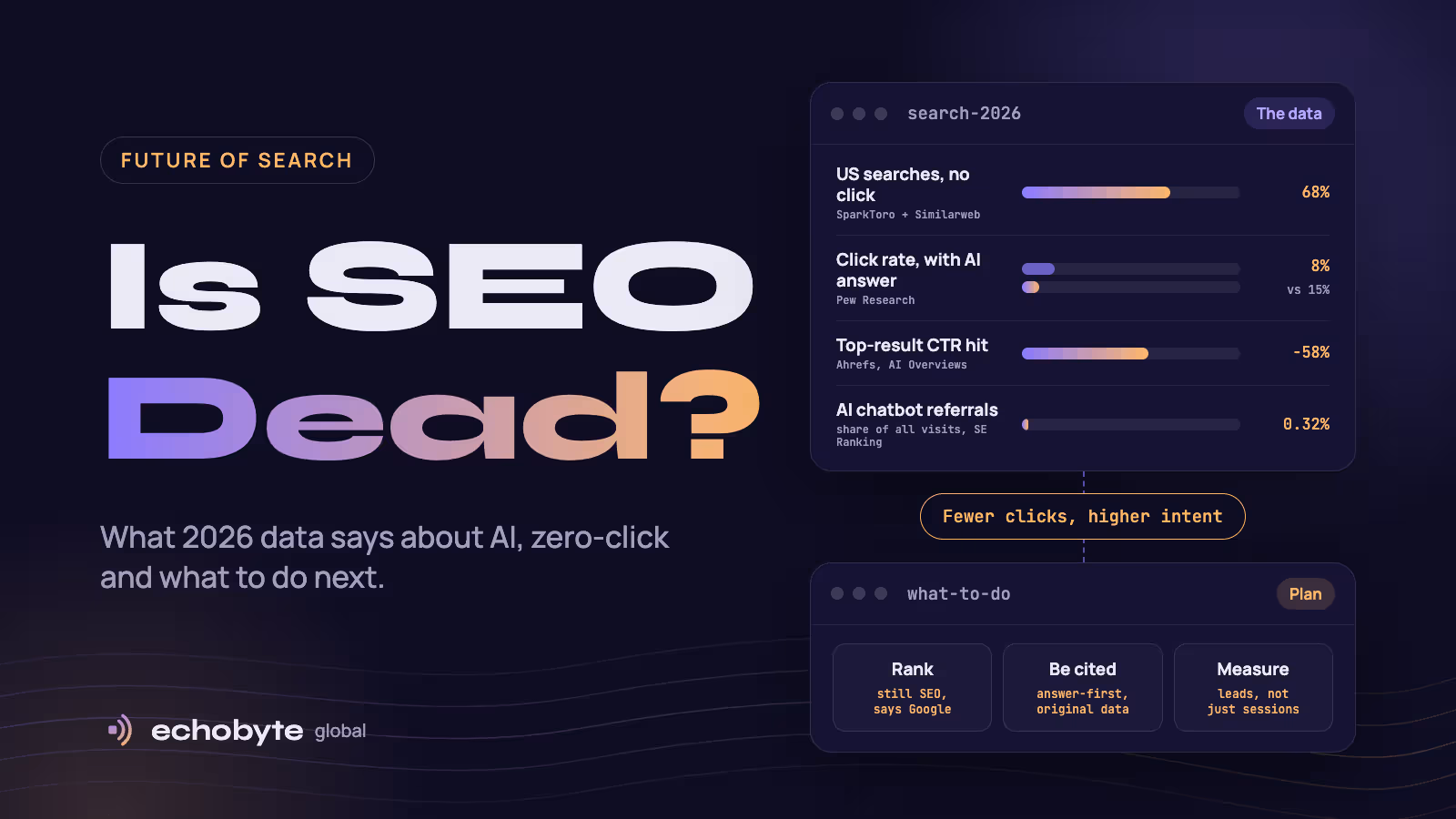
Is SEO Dead? No, SEO is not dead, but the link between ranking and clicks has weakened. Google still answers most searches, its AI Overviews and AI Mode are built on its regular index, and Google says optimizing for them is still SEO. What has changed is that more searches end without a click (about 68% of US Google searches in early 2026), AI Overviews cut the click-through rate of top results by a third to more than half in several studies, and AI chatbots now send a tiny but fast-growing and often higher-converting stream of visits. The practical answer is to keep the fundamentals, aim to be cited as well as ranked, build brand demand, protect your conversions and measure more than sessions.
This guide looks at what “SEO is dead” really means, what the 2026 data shows (and where studies disagree), who is hit hardest, what has and hasn’t changed, how SEO differs from GEO and AEO, and a ten-step plan with a measurement framework. We do SEO for a living, so we try to be straight about what it can and can’t do. Figures were checked in November 2026, and most come from third-party studies with different methods.
Key takeaways
- Most searches now end without a click, and AI answers reduce clicks on top results. The decline is real but uneven.
- AI chatbots send only about 0.3% to 1% of visits on average, but the visitors tend to convert better, and the share is growing fast.
- Google says AI features need no special optimization beyond good SEO. The goal widens from ranking to being cited and remembered.
- Informational “how to” content is hit hardest. Local, transactional and branded searches keep more clicks.
- Judge SEO by leads and revenue, not only organic sessions.
What does “SEO is dead” actually mean?
It usually means one of two things, and only one is true. The true claim is that organic traffic from informational queries is falling for many sites because search results answer the question directly. The false claim is that search optimization no longer matters. People still search billions of times a day, Google still ranks pages and its AI features still pull from the sites it indexes. What is dying is the easy model where ranking first for a definition reliably produced a click. If your plan depended on that, it needs to change.
What does the data say?
| Study | What it found |
|---|---|
| SparkToro and Similarweb (June 2026) | 68.01% of US Google searches in January to April 2026 ended without a click, up from 60.45% in 2024, with about 276 open-web clicks per 1,000 searches |
| Pew Research (searches from March 2025) | Users clicked a traditional result in 8% of visits with an AI summary, against 15% without one. They clicked a link inside the summary in about 1% of visits |
| Ahrefs (300,000 keywords, December 2025 update) | AI Overviews lowered the click-through rate of the top result by 58%, after an earlier estimate of 34.5% |
| Seer Interactive (informational queries, June 2024 to September 2025) | Organic click-through rate fell from 1.76% to 0.61%, a 61% drop. Brands cited in the overview got about 35% more organic clicks than uncited ones |
| Ahrefs (March 2026) | About 38% of AI Overview citations came from pages ranking in the top 10 |
| SE Ranking (2026) | AI search sends about 0.32% of all website visits, up 16 times since 2024. ChatGPT sends about 75% of that |
| Conductor (13,770 domains) | AI referrals were about 1.08% of website traffic |
Sources: Search Engine Land on the SparkToro study, Ahrefs, Search Engine Journal on the Pew and Seer studies and SE Ranking. Treat the numbers as directions, not exact values. The panels differ between years (SparkToro compared a 2024 Datos panel with a 2026 Similarweb panel), the studies cover different query types, and some measure relative changes while others measure percentage points. One analysis notes that going from a 10% to an 8% click rate is a 20% relative decline but only two points.
Two points often missed: AI Mode, which has the highest zero-click rate in Semrush’s data at about 92% to 94% of sessions, accounted for only about 0.34% of US searches in the SparkToro study period. The bigger driver of the rise in zero-click searches is AI Overviews and other answers on the results page.
Do AI visitors convert better?
Usually, but studies disagree widely. Because the visitor has already read an answer and chosen to click, intent tends to be higher:
| Source | Finding |
|---|---|
| Similarweb (2026) | AI referrals convert at 11.4%, against 5.3% for organic search |
| Ahrefs (its own site) | 0.5% of visits from AI search produced 12.1% of signups |
| A B2B benchmark of 500+ sites | 14.2% from AI referrals, against 2.8% from Google organic |
| Digital Applied (2026) | 3.49% against 2.86% for organic, a much smaller premium |
The range, from about 22% higher to several times higher, depends on the sites and what counts as a conversion. Volumes are small today, so AI referrals are a bet on direction, not a replacement for Google traffic. Google organic is still about 42.75% of all website traffic in SE Ranking’s data, roughly 134 times AI’s share.
Which sites are hit hardest, and which least?
| Type of search or business | Effect |
|---|---|
| Informational (“what is”, “how to”) content | Hardest hit. One compilation puts zero-click rates near 74% for informational queries |
| Local and service searches | High zero-click rates (about 72%) from maps, packs and answers, but calls and directions still convert |
| Commercial investigation (“best”, “vs”) | Moderate (about 46%), and a good place to be cited |
| Transactional (“buy”, “pricing”, “near me”) | Lower zero-click rate (about 31%), so clicks still happen |
| Branded searches | Often stronger. Amsive found click-through rate for branded queries with AI Overviews up about 18% |
The zero-click-by-intent figures come from a Semrush-based compilation, so treat them as indicative. The pattern fits what many sites report: definition and how-to articles lose the most, and bottom-of-funnel pages hold up best.
What has changed in search?
- The results page answers more. AI Overviews, featured answers, maps and shopping modules satisfy many searches without a visit.
- Rank is a weaker predictor of visibility. Only about 38% of AI Overview citations came from top-10 pages in Ahrefs’ study, so citations and rankings are related but not identical.
- New discovery channels exist. ChatGPT, Gemini, Perplexity, Copilot and Claude send traffic and recommend brands.
- Brand matters more. Cited and well-known brands earn more clicks, and branded searches hold up better.
- Measurement is harder. Sessions alone no longer show whether SEO is working.
What hasn’t changed?
- Google’s AI features sit on Search. Google’s May 2026 guide, “Optimizing your website for generative AI features on Google Search”, says AI Overviews and AI Mode depend on its ability to crawl, index, understand, retrieve and trust useful pages, with no extra requirements.
- Technical foundations. If Google cannot crawl or index a page, nothing else works.
- Helpful, original content. Pages that answer real questions with evidence and experience are still the raw material for both rankings and citations.
- Spam rules. Google updated its policies to apply to generative AI responses, so manipulation such as fake mentions or scaled low-value content is a risk, not a shortcut.
- Trust. Authors, sources, reviews and reputation still count.
- Llms.txt is not required. Google does not treat it as a requirement for its AI features. See our llms.txt explainer for what it does and doesn’t do.
Is SEO different from GEO and AEO?
| Term | What it means | Honest take |
|---|---|---|
| SEO | Making pages crawlable, relevant and trusted so they rank | The base layer for Google and for the Bing index that ChatGPT search uses |
| AEO | Answer engine optimization: being the source for direct answers | Mostly clear structure, concise answers and trusted sources, which is good SEO |
| GEO | Generative engine optimization: being cited by AI systems | Adds off-site presence, brand mentions and measurement to SEO |
Google says that for its own AI features this is still SEO. Other assistants work differently. ChatGPT search leans on Bing’s index and Perplexity runs its own, so the useful differences are where you must be indexed and what third-party sources mention you. Our AI search optimization guide covers the details.
What should you do about it? A ten-step plan
- Fix the fundamentals. Crawling, indexing, speed, titles, headings and internal links. Our website audit checklist has 40 checks.
- Target queries where clicks still happen. Commercial, transactional and local searches, not only definitions.
- Write to be cited. Put the answer first, add original data and examples, name your authors, date your pages and cite your sources.
- Build brand demand. Reviews, communities, YouTube, PR and partnerships make people search for you by name, which is the most resilient traffic.
- Be where AI looks. Make sure your pages are indexed in Bing as well as Google, and that trusted third-party sites describe you accurately.
- Protect conversion. If fewer visitors arrive, each one must count: clear offers, fast pages and an obvious next step.
- Add structured data and keep content in HTML. Agents and crawlers read text, so important content should not depend on scripts.
- Track AI referrals. Create a GA4 channel for visits from chatgpt.com, perplexity.ai, gemini.google.com, copilot.microsoft.com and claude.ai, and watch the Search Console report on generative AI features where available. Our analytics service sets up tracking, and our Google Consent Mode v2 guide covers consent.
- Diversify. Email, communities and direct relationships do not depend on one gatekeeper.
- Review quarterly. Search keeps changing, so revisit your numbers and your plan every three months.
How should you measure SEO now?
| Metric | Where to find it | What it tells you |
|---|---|---|
| Impressions, clicks and click-through rate by query type | Search Console | Whether you are visible and whether AI answers cut clicks |
| Branded vs non-branded clicks | Search Console | Brand demand and discovery |
| Leads, calls, sales and revenue from organic | GA4 and your CRM | Whether SEO pays |
| Visits from AI assistants | GA4 referral and channel reports | Early volume and conversion from AI |
| Citations in AI answers | A monthly test of 20 customer questions | Whether assistants recommend you |
| Share of voice against competitors | Manual tests or a visibility tool | Whether you are gaining or losing ground |
AI referrals are often under-counted in analytics because some assistants strip referrer information, and one benchmark suggests teams can undercount AI-driven pipeline by two to three times, so treat the numbers as a floor.
What does this mean for local and service businesses?
Searches for a plumber, an HVAC company or a dentist still end in calls, directions and bookings, even when there is no click to a website. Your Google Business Profile, reviews and phone number matter as much as your pages. Our HVAC SEO guide shows how a local service business gets found, and our AI receptionist cost guide covers making sure the calls get answered.
What might happen next?
These are predictions, not facts. Expect AI answers to appear on more queries, the line between AI Overviews and AI Mode to blur, and more of the buying journey to happen inside assistants. Expect measurement to improve slowly, with more reporting from Google and analytics tools. And expect the same thing to stay true: sites that are trusted, useful and easy to read will be the sources these systems rely on. Our guide to AI agents for small business looks at the automation side.
How can Echobyte help?
Our SEO service starts from $600 a month and begins with a technical audit. It has no ranking guarantee, because nobody can honestly offer one, and we report on leads and calls, not only traffic. Our web development service builds sites with metadata, sitemaps, structured data and llms.txt ready from day one, and our analytics service sets up conversion and AI-referral tracking. See our SEO pricing guide for what SEO typically costs, and our pricing page for starting prices.
Is SEO dead? FAQ
Is SEO dead in 2026?
No. Google still ranks pages, and its AI features are built on its index. But more searches end without a click, so the goal expands from ranking to being cited, remembered and chosen.
Will AI replace SEO?
AI changes how results are shown and how people find businesses, but it still needs sources to cite. The work shifts toward clearer content, trust and measurement, not away from search.
Is SEO still worth it?
Yes, for most businesses, especially those with commercial, local or transactional searches. Expect slower, less predictable traffic from informational content and plan for more than clicks.
How much do AI Overviews reduce clicks?
Studies range from about 15% to over 60% depending on method and query type. Pew found clicks on traditional results fell from 15% to 8% of visits with an AI summary, and Ahrefs found a 58% lower click-through rate for the top result.
What is a zero-click search?
A search where the user gets an answer on the results page and does not visit a website. SparkToro and Similarweb found about 68% of US Google searches in early 2026 ended this way.
What is the difference between SEO, GEO and AEO?
SEO makes pages rank, AEO focuses on being the source of direct answers, and GEO focuses on being cited by AI systems. Google says optimizing for its AI features is still SEO.
How do I get cited by ChatGPT or Google AI Overviews?
Be indexed (including in Bing for ChatGPT), publish helpful pages that answer questions directly, add original data and clear sources, and build mentions on trusted third-party sites.
How should I measure SEO now?
Track leads, calls and revenue, branded and non-branded clicks, AI referrals in GA4, and monthly tests of whether assistants recommend you.
Want an honest view of how search changes affect your site? We audit your site, show where you still win clicks and set up tracking, and every project starts with a free discovery call and a fixed quote.
Sources
- Google zero-click searches reach 68% in early 2026, Search Engine Land, summarizing SparkToro and Similarweb
- In 2026, Less than One Third of Google Searches Still Send a Click, SparkToro
- AI Overviews reduce clicks: update, Ahrefs
- Google’s AI Overviews and organic click-through, Search Engine Journal, covering Pew Research, Seer Interactive and Amsive
- AI traffic grew 16x from 2024 to 2026, SE Ranking
- AI Search Referral Traffic Benchmarks 2026, Data-Mania
- Conductor’s 2026 AEO/GEO Benchmarks Report, summarized by Remote Work Europe
- Google’s New AI Search Guide Calls AEO And GEO ‘Still SEO’, Search Engine Journal, May 2026
- Optimizing your website for generative AI features on Google Search, Google Search Central